Showing posts with label LGBTQ. Show all posts

Tuesday, February 1, 2011

Happy Black History Month & Langston Hughes Day (Poems)

Today begins Black History Month, which is celebrated throughout the month of February in both the United States and Canada (in UK it occurs in October). It became an official US celebration in 1976, though its origins date back to scholar-activist Carter G. Woodson's establishment of Negro History Week in 1926. It is also, happily, Langston Hughes's birthday (1902-1967). I have posted more than a few Langston Hughes poems on this blog, and relish any opportunity to do so.

A draft of Hughes's "Old Walt"
Here are of two of his most famous poems, from Montage of a Dream Deferred (Henry Holt, 1951), both in direct conversation with each other. Note the light, jazzy, celebratory but ultimately critical tone of the first contrasting with the graver and more somber tone of the second, which I had to memorize and recite as a child (ah, the 1970s!). Both also might be read metonymically in relation to African America as it was in his day, and our own.

GOOD MORNING

Good morning, daddy!
I was born here, he said.
watched Harlem grow
until colored folks spread
from river to river
across the middle of Manhattan
out of Penn Station
dark tenth of a nation,
planes from Puerto Rico,
and holds of boats, chico,
up from Cuba Haiti Jamaica,
in buses marked New York
from Georgia Florida Louisiana
to Harlem Brooklyn the Bronx
but most of all to Harlem
dusky sash acros Manhattan
I've seen them come dark
wondering
wide-eyed
dreaming
out of Penn Station--
but the trains are late.
The gates open--
Yet there're bars
at each gate.
What happens
to a dream deferred?
Daddy, ain't you heard?

***
 
HARLEM

What happens to a dream deferred?

Does it dry up
like a raisin in the sun?
Or fester like a sore--
And then run?
Does it stink like rotten meat?
Or crust and sugar over
like a syrupy sweet?

Maybe it just sags
like a heavy load.

Or does it explode?

Both poems © Copyright, Estate of Langston Hughes, 1951, 2011. All rights reserved.

Friday, January 28, 2011

On David Kato

David Kato (Photo: Frontline, CAHR)
Gukira has one of the best (as always), most thoughtful and considerate memorial posts I've read on David Kato (Kisule), the Ugandan teacher and LGBT rights activist, who had served as advocacy officer for Sexual Minorities Uganda (SMUG).

Kato was brutally beaten to death in his home on Wednesday, January 26, 2011. As the New York Times reports, Kato was one of a number of people Rolling Stone, a notorious Ugandan newspaper, identified as "homosexual" and targeted under the banner "Hang Them." He had been repeatedly threatened and attacked over the years, and had just won a legal decision against Rolling Stone. Uganda’s High Court ordered the magazine financially compensate those it had attacked and to stop publishing the names of people it claimed were gay.

His murder also occurred within the context of Uganda's parliamentary debates about making homosexuality a capital crime, a move directly fostered by US evangelicals, as the Times reported early in January of this year.  In fact it was shortly after a 2009 visit by US evangelicals that Uganda's Parliament began pushing a law to capitalize being gay, though pressure from the US led Ugandan president Yoweri Musaveni to disavow the law. It nevertheless could still be enacted. (Here's the Times's presentation of the views of four Ugandans, including a transman, on the issue.)

I won't even try to reprise Gukira's post, but I'll just quote a small section:
A quick look at his Facebook page tells one story. Early this morning, messages from January 3 and 4 congratulated David on the win against the Ugandan Rolling Stone. Just above them, expressions of loss and solidarity, of love and courage, of mourning. This juxtaposition enacts a certain kind of work to which I hope to return in this edit.

From what I know, which is to say, from the available evidence, it is not clear that a direct line can be traced from David’s activism to his murder. I write this not to be contrary, but because I think it’s important to be judicious, to be contextual. Simultaneously, and just as importantly, there is no evidence that his murder was not a result of his activism. For now, his death remains something that can be used in any number of ways.

Please do read the rest.

RIP, David Kato (1964-2011)


Tuesday, December 14, 2010

C's New Apps, Cooking, Sound Machines & More

Back in July I'd written that C had created and debuted his first app, the fashion-forward, informative MBF TrendTalk, for the MBF consulting company and its site.  (The next New York Fashion Week is coming up in a little over a month, so it's an app to have if you want to be on top of things.) Since then he's been working steadily on new apps, and his company, CAC-IT has since introduced several new free or very affordable apps that are either available or will soon be via the iTunes store.


The second was C's Holiday Kitchen, a holiday cookbook for the iPad, featuring some of his delicious, failsafe holiday recipes, ranging from the staples like roast turkey, apple and sausage stuffing, collard greens, and homemade cranberry sauce, to desserts like coconut cake and sweet potato pie, to dinner rolls you cannot mess up nor stop adding to your plate.  He has since updated this app and introduced an iPhone version, C's Holiday iKitchen, which is now also available on iTunes.  I recommend trying out the cranberry sauce if you've never made it before; it's so simple it will shock you and you'll never want to go back to canned cranberry sauce again.

Two of his newer apps are in the Apple pipeline: the first is my favorite of all, the Soundbox Celebrator, which is a virtual iPhone sound machine for the holidays, sporting events, and anytime you want to punctuate your thoughts and comments with loud audio accompaniment.  It includes a variety of sounds, including an air horn, church bells, and my favorite, the vuvuzela, as well as a stately version of "For Auld Lang Syne," with the lyrics in case you're too blitzed to remember them.  I hate to admit it but had this been available when I was in high school, I very well might have been expelled as a result of it! (As it was, we had to make do with Bic pens, spitballs, and a laughing machine, which nearly sent my elderly German language teacher into apoplexy, but that's another story....)

The second is a lifestyle and travel app for Monaga, covering the the full range of LGBTQ life and activities in the Dominican Republic and more. The app will feature links to Monaga's main page; the legendary Monaga blog; and a Monaga-designed map showing gay and tourist highlights for Santo Domingo-area travelers.  As Joan Crawford in Mommy Dearest might say, it will ensure travelers know where to find "the booze, beaches, and boys!" As I said, it's in the Apple pipeline as well, and should debut quite soon.

Since I don't have the skills to program more than simple html these days, I'm very impressed by all of this, and I urge you to check these out if you're interested, and check with iTunes or CAC-IT's site to see what apps C is devising down the road, or to inquire about getting your own.

Saturday, October 16, 2010

It Gets Better/You Grow Stronger Project

"Only difficulty is stimulating..." - José Lezama Lima

While I as an out, black, gay man strongly endorse the general idea behind and the creation of the "It Gets Better" project and series of videos initiated by Dan Savage* to address the recent slew of suicides by bullied, harassed and violated queer and questioning youth, such as Rutgers University freshman Tyler Clementi, I have been slow in posting one, despite my acknowledging that it might prove helpful to the very few who might view it (which is why I very likely will soon post one). I feel this way in part because, based on my own life and the lives of those queer people whom I've known, I believe it isn't so much that things get better--especially if you are black, and working-class or poor, and a woman or a transgender person, and differently abled, and geographically isolated, etc.,--as it is that you get stronger. (Gukira discusses this with his inimitable brilliance on his blog.)

It's that you learn to address, rather than adapt or mould yourself to, the world's disdain for you, your invisibility and objectification, how little so many people, including loved ones who are not LGBT and some who are, really do see you or care about your existence. You learn to raise your innate antennae, sharpen and clarify your senses, develop new spiritual, psychological and emotional muscles, through your experiences, thereby allowing you then to move through the world with increasing self-awareness, resistance, confidence, joy. It may not always seem better or easier, but often it may. You can become stronger and more knowledgeable about yourself, and about others like you; you can come to see that the despair you have felt may sometimes place you right back on the edge--of something, some place, including life itself--but now you realize you are able to take a step back and turn in a different direction that will include reflection and affirmation, self-reflection and self-affirmation: and you keep on going, keep going on.

And as you keep going, you can increasingly create a life and enjoy it, shape the world around you such that you are able to experience it fully, to be present in it, connect with, understand, and love people like you and unlike you, including even people who cannot possibly imagine the worlds you're moving in, your complexities and nuances, because they cannot and do not want to see them. Because sometimes, as a result of their own limitations, they want to erase them--and you. Because you are stronger you can drop the armor you often have had to wear to protect yourself--not toss it aside, but at least step out into the world without all of it. You do not have to cry yourself to sleep. You do not have to wake worrying that, with a parent or sibling refusing to offer you the sort of unconditional love they claim they're capable of, or that the God they believe in is capable of, you are utterly alone. You do not have to feel that whenever you speak it's as if you are speaking into a void. You do not have to hide who you are, for fear of the repercussions of being yourself.

Because your strength and self-knowledge and broader knowledge have deepened, have grown richer and firmer, are available to you at all times, and will keep on becoming more so, not despite but as a result of the vicissitudes, the pain, and yes, the victories, and happinesses you experience. All of it will make you stronger if you let it, if you act upon them and make yourself stronger. Perhaps you might see this as better, and that is wonderful. But stronger, definitely, is something you can achieve, and thus, live and thrive.


--
*I want to note that my respect for Dan Savage dropped precipitously when, after the initial Proposition 8 vote in California, he rushed to lay blame at the doorstep of Black Californians. I can and do forgive all the time, and unequivocally so, but I also cannot so easily forget what was an appalling display of the most simplistic thinking and ready-at-the-drop-of-an-election racism. As studies later showed, if Black voters had not voted in that election, Proposition 8 still would have passed. Perhaps Savage later apologized, but if so, I never saw it, because I have studiously tried to stay away from his blog and columns. I also should note that his brother is a colleague of mine, and I think the world of him.

Tuesday, August 31, 2010

Events from July & August, Part 5

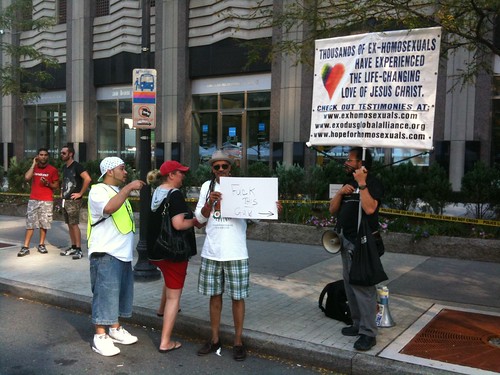
People confronting anti-gay protester
People confronting an anti-gay protester, Jersey City Pride festival

Jersey City Pride Festival
Jersey City Pride festival

Bryant Park before a film

Washington Sq. Park
In Washington Square Park (this was the first time I'd been in the park since the renovations, which are still underway)

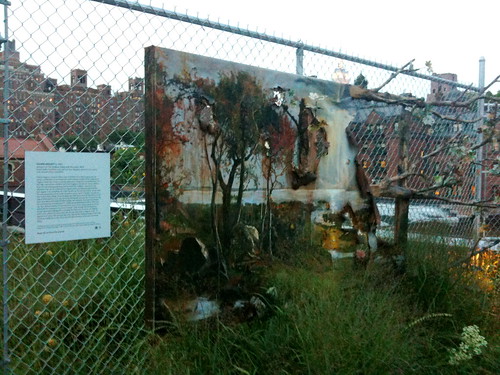
Art on the High Line
Art on the High Line, Chelsea

Flowers on the High Line
Wildflowers, on the High Line

On the High Line
The Empire State Building, from the High Line

Artwork on the High Line

Saturday, May 22, 2010

Harvey Milk Day + Translation: Guillaume Dustan

Happy Harvey Milk Day!

****

Five years back, after learning of his death, I wrote about Guillaume Dustan (1965-2005), the enfant terrible of late 20th century French gay male literature. I won't restate all of that here, except to note that around the age of 30, he began publishing a series of novels, drawn directly from his life, that placed him squarely at the center of the French autofiction movement, in which autobiography and fiction are so closely merged that they unsettle the question of genre. Dustan published 8 or 9 books, most of them fiction but several works of philosophical essays, especially on the topic of queerness, before his death, from an accidental drug overdose. He was also an editor for Balland's now extinct Rayon Gay line--which I also wrote about on here, and which is how I first learned about and had a brief email exchange with him, getting clearance for a translation--and a film producer and actor. Dustan's first three books, only one of which, Dans ma chambre (In My Room) from 1996, has been translated, are pulse-like accounts of his very active sex-and-love life, but they are also shorn of sentimentality; the concise, speedy, casual prose paints a rich picture, often full of feeling, without evoking affect in the usual ways. In 1999, he published the novel Nicolas Pages, which was somewhat of a departure. Denser, more full of anecdotes, digressions, and self-analysis and philosophizing, it takes up Dustan's pursuit of and relationship with the eponymous, younger author and conceptual artist,
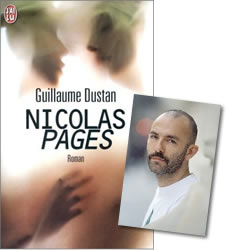
Nicolas Pages (1970-, at right), who had only a few years before, in 1997, published his first book, Je mange un oeuf, which I've I translated a portion of.  I subsequently did translate some of Dustan's novel, and realized this week, while teaching a unit on conceptual writing and rereading the works of Kenneth Goldsmith, Rob Fitterman, and Tan Lin, that one way to think about Pages' first novel, and a good deal of the more chronologically-grounded, stylistically flat or affectless, verisimilitudinous works like Pages, would be as a form of documentary realism, or conceptual fiction. Pages, as I noted is a conceptual artist, but as far as I can tell, I haven't seen that link made in US criticism, though Pages and Dustan are frequently linked to Bret Easton Ellis, whose influence is evident in their work, and whom both approvingly cite repeatedly. (Other writers whose names have been evoked in relation to both are Renaud Camus, HervĂ© Guibert, CĂ©line, and the American queer master Dennis Cooper.) One great aspect of reading and translating Dustan's Nicolas Pages was seeing his appreciation of Pages' first book stated so clearly and forcefully in the opening pages of the novel; I have long wondered if it was just me who saw validity in what Pages was doing. Now that Goldsmith and company are big, perhaps there will be more appreciation for at least some of their counterparts, especially Pages and the late Dustan, overseas.


Here's a little snippet from Nicolas Pages (Éditions Balland, 1999, winner of the 1999 Prix de Flore), which gives a flavor of the jagged, sometimes snaky qualities of the prose (the infelicities of the rough translation are all mine), and the self-referentiality of the narrative:

It happened like this. He was late getting to FNAC Saint-Lazare for an FG radio blah-blah with Alain Royer and Gwen Fauchois. Then we figured that he couldn't be far away, his bags were already there, set up. We had to start. I'd put on my wig, to get myself together, to make an impression too. I found it comical to put a wig to go on the radio. I took a small jog around the book display gondola--on casters--sitting at the entrance to the room (my choice: my girlfriends' gay books from the press). And then there he was. First the head and the top of his usual soft T-shirt neither too wide nor too tight, up to this point black or blue, today green, atop the black mesh. The hair was a little longer than in Liège, but still short and you could see that although he had left a longer strip, one end of the crown was higher on the right, or perhaps on the left. His eyes were still brilliant too. His face so expressive, but reserved. I also still found it gorgeous. Everything happened very quickly. I was happy to have the wig, it gave me a little distance. We got to work. I spoke about why the wig ("for a peaceful coexistence between the male and female in the same person"). He read a passage from my book, the one where I cite "Sweet Dreams." I thanked him. I read a passage from his, I don't know which one, I had just gotten up to go look for an example in the stacks he'd left here for FNAC, this cunt still hasn't faxed me his invoice sheets, it's the hugest rush right now, he's going to move to in New York on July 11th, it's June 29th now, I settle on the Mykonos trip, I read, I hear his voice speaking the text, it drives me crazy, it drives me as crazy as in Mykonos, contrary to my memory, he doesn't stop fucking, I'm jealous, I'm jealous even when he speaks about people that I do not know of, from a time when I did not know him, I am really blown away, I am serious. I said that I thought that his book was the most important book since American Psycho (besides mine, I thought). That's really what I think. He thanked me. He spoke. He only spoke of things he was sure about. I appreciated his smarts. I removed my wig so as not to hold the public's attention during his time. After, we placed his book at FNAC, while drinking champagne with Alain, Gwen and some people in the bar, nice people. Nicolas likes to drink. He drinks but he maintains control. It's because of that that I started to like him. He brought back to me my proud youth. I was someone beautiful before I lost my principles. He's handsome like a cowboy, like Rahan, like Doctor Justice (two nights later, at Dispatch, where he's at the bar, ordering—he goes all the time to order drinks and he rolls pretty good joints also, more than me but it's normal since he sees what I have to do, he says nothing. He's hovering before me, the back of his black Adidas top two centimeters above. I touch him thinking that it's maybe not a good thing. I touch him thinking that I'm against public touching, except in the case of an obvious emergency. He looks at me with an air a bit near neutral which means I'm afraid. I think about Quentin who was always feeling me up at the gallery. Nicolas is upstanding. He's 27 years old. I'm 32. We don't have the same history. But no big deal, seeing as though everyone has the same one. I hope that we'll have enough points in common. Up to the age of 24 I never made any effort. I had the power to not want to please anyone. I no longer said the obvious things. Only a half-word, if anything).

Copyright © Guillaume Dustan, from Nicolas Pages, Éditions Balland, 1999, 2010. Translation, John Keene, 2003, 2010. All rights reserved.

Monday, May 17, 2010

IDAHO (Int'l Day Against Homophobia and Transphobia) + Harvey Milk Week of Action in Chicago

It's May 17, which means it's also International Day Against Homophobia and Transphobia, or IDAHO. The brainchild of Dr. Louis-Georges Tin, a black gay scholar, writer and activist (with whom I conducted an interview several years back, accessible here), IDAHO began 5 years ago, after Tin began an initiative, in August 2004, to create a truly global International Day Against Homophobia. His aim was for "universal recognition" of this day, and he proposed that it be fixed on May 17, "to commemorate the World Health Organisation’s decision to remove homosexuality from the list of mental disorders." Since May 17, 2005, numerous countries and groups within those countries have called for an end to homophobia and transphobia, and a push to decriminalize "homosexuality" has also spread. The idea behind today is an important one: what would it mean to fight against fear and hatred of and end legal oppression of LGBTQ people?

Central to the logic of the day is that it is homophobia that is the problem, and should be "deconstructed in its social logic and done away with." On the map below, in countries colored blue, there have been or will be events--marches, celebrations, parades, kiss-ins, public speeches--to commemorate IDAHO.

As a cursory glance makes clear, large swathes of Africa, the Middle East and Asia have no participants in today's events. Yet we shouldn't be complacent about the US, either; over the last 10 years the focus among mainstream LGBTQ organizations has shifted to same-sex marriage and repealing Don't Ask Don't Tell (DADT). 5 US states (Massachusetts, Connecticut, Iowa, Vermont, New Hampshire) and the District of Columbia now have marriage equality laws, and the Democratic-controlled Congress's leaders, as well as the President, have expressed support for repealing DADT, though they are dragging their feet right now. Yet passing the the Employment Non-Discrimination Act (ENDA) would arguably have an even greater effect on far more LGBTQ people, since 20 states still have no protection from employment discrimination. In fact, a comprehensive civil rights bill (or Constitutional Amendment) banning all discrimination based on sexual orientation and gender identity would be even more important, since only 13 states have protections to prevent housing discrimination. Same-sex couples or gay single people still cannot adopt children in some states (such as Florida, in part based on the hateful and spurious testimony of hypocrites like George Rekers), and in other states, because of the lack of civil protections, a gay parent can lose custody of her child. Other areas rarely touched upon include discrimination by medical professionals and hospitals, and discrimation against elderly queer people in nursing homes.  These are all issues that still need to be addressed, along with a more equitable economic and political system that ensures that LGBTQ people, like every other American, have opportunities for work, to make a decent living, and live and retire with dignity.

In Chicago, this is Harvey Milk Week of Action, which includes a full schedule of events, from rallies to teach-ins to flashmobs, to commemorate what would have been Harvey Milk's 80th birthday, and to also discuss and speak out against homophobia, transphobia and heterosexism both in the US and across the globe. The culminating event will be a rally at 1 pm in the Loop this Saturday, May 22, 2010, Harvey Milk Day, his birthday and the day California has designated to commemorate him. 

Equality Across America has a listing of other Harvey Milk Day events across the US, so please take part if you're able to do so!

Reggie H's take on the day is up too!

Saturday, March 20, 2010

Lt. Dan Choi, Freedom Fighter

On Thursday, West Point graduate, Iraq War veteran and New York National Guardsman Lieutenant Dan Choi (above, photo from Qweerty.com) powerfully concluded a Human Rights Campaign (HRC) rally, featuring comedienne Kathy Griffin, to repeal the abhorrent and failed Don't Ask, Don't Tell (DADT) policy with direct action: he and Captain Joe Pietrangelo II, who unsuccessfully tried to take his discharge as a result of DADT to the Supreme Court, chained themselves to the White House's gates. According to Qweerty's report, GetEQUAL co-founder Robin McGehee was arrested for helping Choi lock himself to the gates. HRC head Joe Solomonese and Griffin allegedly agreed to accompany Choi to the White House, but neither did. Griffin also supposedly had cameras on the HRC rally premises, for her show, but it's unclear if they captured Choi's protest.

From YouTube user goodboydc (John Aravosis), video of Lt. Dan Choi handcuffing himself to the gates:


From Lt. Choi's press release:

“Hello. My name is Lt. Dan Choi. I am being discharged from the US Army because I am gay and dared to say it out loud.

Today, I am here on a mission with Capt. Jim Pietrangelo, and we are asking you all to join us. We’re calling you to action because we are at a turning point — a moment in time where talk is no longer enough, and action is required.

Equality is not going to happen by itself.

You have been told that the President has a plan. But Congressman Barney Frank confirmed to us this week that the President still is not fully committed to repealing Don’t
Ask, Don’t Tell this year.
And if we don’t seize this moment it may not happen for a very long time.

Some may tell you that I am one of the lucky ones. I have been welcomed back by my unit with open arms. And it would be easy for me to stay quiet and hope that change will happen.

But what I was taught at West Point and learned in war is — hope is not a strategy. As officers, James and I both find it a dereliction of our moral duty to remain silent while thousands of our brothers and sister are not allowed to serve openly and honestly.

Capt. Pietrangelo was honorably discharged under Don’t Ask, Don’t Tell in 2004 and I will be subject to the same shortly. As officers we are here today fighting for those in the ranks, and we need our Commander in Chief to do the same.

Our fight is not here at Freedom Plaza, it is at the White House. We are walking to the White House right now to send the President a message. So…take out your cell phones and your cameras.

Document this moment. Join us as together — we make history.”

Tuesday, February 2, 2010

Illinois votes + Amazon vs. Macmillan + Tissue as commodity + Golden Girls grow gays

Today's Primary Election Day in Illinois, and a number of key posts are on the ballot, from the US Senate seat, formerly occupied by President Barack Obama and now by his notorious successor, Roland Burris, to the Governors' seat, whose previous recent occupants include a convicted felon (George Ryan) and a man (Rod Blagojevich) who tried to sell the just-mentioned Senate seat to the highest bidder, was impeached by the state legislature, and will soon appear on a TV reality show, to various municipal and local positions, including one that almost no one outside of the state knows about but which has been a rag of contention for years, the powerful Cook County Board President's office. That seat is currently occupied by Todd Stroger, whose father suffered a massive stroke, thereby handing the gig to his son.

Since I vote in New Jersey, I'm a spectator in all of this, but I have to say that while I was somewhat frustrated with the lackluster options in the New Jersey elections that put Rovian Republican Chris Christie in office, I would feel even more disillusioned if I had to choose from the rogues' and hacks' gallery vying for these various Illinois seats. Let's just take the US Senate seat. On the GOP side, the leader is Mark Kirk, a sometimes moderate (by Midwestern standards), sometimes right-wing Congressman representing Chicago's wealth North Shore. Kirk was outed as gay, via a really sleazy media-leaked rumor, by one of his GOP opponents, a very nasty operator named Andy Martin, who has zero chance of winning. Facing almost no real competition Kirk, who ha moved politically to the right to secure the nomination, will very likely win the GOP nomination, where he'll face young, fairly progressive Democratic projected-winner Alexi Giannoulis, the current State Treasurer. (David Hoffmann, the state Inspector General, a former Federal prosecutor, and a truly progressive candidate with a clean (including anti-Daley) record, probably doesn't have a chance, but if he did, he would make the best Senator out of all the candidates.) Ironically enough, Giannoulis's family mint and former employer, Broadway Bank, is in serious financial trouble as a result of its lending policies over the last 8 years. During Giannoulis's tenure as Chief Loan Officer from 2002 to 2006, Broadway Bank jumped heavily into the subprime lending business and other risky banking activities. While Giannoulis has argued that he wasn't really involved in the problems that now place Broadway Bank on the brink, a review of the record belies this. As Treasurer he's done a decent job, particularly in the midst of the current economic calamities, which have hit Illinois, the nation's 6th most populous state, very hard, but his banking tenure, and his refusal to be explicit about his role in it, are troublesome.

On some of the major issues facing Congress, and in particular the Senate, it's clear where these two will land. Kirk has been reciting the GOP's health care initiatives mantras, which will do little to improve the ongoing health care cost crunch or resolve the longer time economic crisis the country faces, while Giannoulis would be a reliable vote for the current Senate health care/insurance reform bill, down to supporting Obama's flipflopped position on taxing higher cost plans, yet he also would probably support a reconciliation bill that included more progressive reforms like a public option. Kirk seems likely to oppose major banking reform, while Giannoulis, whose family firm would be affected by the legislation, probably would back it. On national security, Kirk appears likely to back any administration initiatives that track closely to Bush's, which is to say, most of them, while Giannoulis could very well be a firm supporter of Obama's on many national security initiatives, but also outspoken on ones that progressives have identified as particularly problematic, such as the delayed closure of Guantánamo, the glacial withdrawal of troops from Iraq, and so on. As to whether Giannoulis can defeat Kirk in the general election will come down to the general economic conditions in the state, how well he can appeal to people in the populous, centrist ring counties around Chicago, how vigorously he deflects criticism of his family bank's fiascos, and how much he delineates himself from the Blago-tainted Democratic cast. Kirk's chances will depend upon how much voters across the state are willing to hold their noses and vote for a Republican, people's sense that he would be willing to work with the Democrats and Obama as opposed to being yet another GOP obstructionist, and how many Chicagoans and Chicagoland suburbanites show up for the general election.  The after-effects of the outing and his denial will have little effect at all, because Giannoulis, like Burris, has a strong pro-gay record and wouldn't use Kirk's hypocritical record against him.

And so it goes down the line. The country and state are in sad shape, and many of today's leading candidates appear to offer little in the way of viable solutions for the nation's or state's problems.  There are Green Party candidates running in a lot of these races, and if I could vote here, some of them would get my vote, but I also don't think hardly any of them have a realistic chance to win in the upcoming general election. One candidate has stood out for me: Democrat S. Raja Krishnamoorthi (above right, Huffingtonpost.com) a former Obama campaign employee and current candidate for the Illinois Comptroller position. One of his ad taglines is "Another candidate with a funny name," and his commercials and posters emphasize "RAJA," with the aim of getting people outside Chicagoland to vote for him (he grew up in Peoria, about as middle-American as exists).  Based on his background and record, he appears to be one of the best options Illinois voters will have today.

###

Returning to the publishing tip, one of the most noteworthy issues this week has been the battle between mega-retailer Amazon, the largest online bookseller in the country and proprietor of the Kindle e-reader, and Macmillan (part of the McGraw-Hill conglomerate, I believe), over a pricing dispute. To summarize, Macmillan objected to Amazon's loss-leader pricing of e-books at $9.99, and wanted to sell e-books for more, by moving from a wholeseller model to an agency model. The fact that Apple just debuted its iPad, which represents direct competition to the Kindle, and agreed with the country's five largest publishers (Hachette Book Group, HarperCollins Publishers, Macmillan, Penguin Group, and Simon & Schuster) to sell e-books at a higher $12.99-$14.99 price point, threatened Amazon's power and buttressed Macmillan's complaint, since the publisher would be undercutting themselves by selling books at differing prices on a similar platform. Amazon responded in brutal fashion by severing all purchasing access Macmillan's books, not only removing buy buttons from Macmillan's print books on the Amazon website, but also also cutting Kindle owners' and user's access to Macmillan's texts.  Just like that.

Quoting the Publisher's Lunch site (I don't have login access, but h/t to Lisa M.):
Among the books subject to the greatest potential short-term effect of Amazon's buy-button removal is Andrew Young's just-released THE POLITICIAN, which curiously still ranks at No. 9 on Amazon's bestseller list (and has been between No. 4 and No. 6 today at Barnes and Noble.com). Hilary Mantel's WOLF HALL was at 69 on Amazon last night, falling steadily today and now at No. 128. Atul Gawande's THE CHECKLIST MANIFESTO: How to Get Things Right was at 34 last night on Amazon, now at No. 66,--and has risen from 112 up to 86 at BN.com in the same time period. (These numbers change slightly every hour we've been checking them.)


Amazon has now relented, but larger issues remain. What is an equitable price for e-books, which do not require much of the cost of hardcopy books; there's no physical printing or storage or shipping involved, so should they be priced as anywhere near as high as trade paperbacks? How much power and control should any retailer or hardware company like Amazon have over publishers, and should a retailer which is also a hardware maker also be allowed such overwhelming control the means of distribution? Yet on the other hand, if a bookseller is offering a deal that's more financially beneficial to readers, should a publisher be able to trump that?  How should we think and talk about the publishing and distribution systems in light of these dramatic technological changes?  Should the sellers be making the extra profit off these works, as the agency model suggests, or shouldn't that be going to authors, who are responsible for the works themselves--i.e., the content?  And, even more basically, what is an e-book, really?

###

This morning I was given to mull over the deep and historic mistrust many Black Americans, including my own parents and many friends of mine, have had with the medical profession, the government and affiliated private institutions after I read this New York Times story about poor, Black tobacco farmer Henrietta Lacks, who died from aggressive cervical cancer back in the early 1950s. Denise Grady's article discusses a new book, by Rebecca Skloot, The Immortal Life of Henrietta Lacks (Crown, 2010), which explores what Johns Hopkins Hospital did with her cancerous tissue--her body--after her death, how the ubiquitous HeLa cells developed from that tissue have enabled an array of medical discoveries, and even enriched some of the researchers and corporations using it, though not a dime nor, for years any recognition or thanks went to the Lacks family, which was devastated by the loss of this then young mother and wife. Moreover, this all happened without Mrs. Lacks' or her family's consent, or even knowledge.

The racial, class, and educational gulfs between the Lackses and the doctors and researches enabled this, paralleling other Black Americans' experience with the US medical system. According to the article, hoever, Skloot points out similar situations are still occurring half a century, despite beefed up informed consent laws. Courts have tended to side with the scientists as opposed to patients and the family of the deceased, provoking a new movement for "tissue rights" and greater ethical inquiry into who owns removed bodily tissue even in the face of legally binding agreements, and what happens and who benefits, and at what cost, when that tissue--after surgery or death--represents not just a vital element in invaluable, life-saving research, but a valuable commodity as well.

###

Today's laughter link: Christwire: The Golden Girls: How One TV Show Turned a Generation of American Boys into Homosexuals. Two names: Bea Arthur, Rue McClanahan.

Not humorous at all, but a positive sign: Chairman of the Joint Chiefs of Staff Admiral Mike Mullen spoke out strongly today on behalf of repealing the odious "Don't Ask, Don't Tell" policy that has led to the discharges of thousands of valuable military personnel. Unfortunately, we do not need another year of "study." Ask the UK, Israel, and other countries for pointers, and take lessons. Just get it done, and swiftly!

Thursday, December 24, 2009

60 Makes a Bill + Pushing from the Left

Delivered, but not sealed or signed--yet, and the US Senate's version of the historic yet problematic health care "reform" bill, that is. With 58 Democratic votes and the those of the two independents who caucus with them, the Democrats passed the severely gutted, lobbyist-shaped, and insurance industry-and-Big Pharma-friendly health care "reform" legislation. Now it heads to conference, where some contentious issues must be ironed out before it can be revoted up by both houses and then sent to President Barack Obama to be signed into law. Despite his aloofness from the turbulent Congressional debates, he's said he'll now get involved. I'll believe it when he does it.

Senate Democrats
Senate Democratic leaders announcing the passage of the legislation

The Senate bill
  • has no government-run health insurance (i.e. public) option.
  • has no Medicare buy-in for people under the current age of eligibility. (A recent Quinnipiac polled showed 56-38% support for the public option and 64-30% support for Medicare expansion.)
  • still includes the very mandate that President Obama campaigned against, and does not "cover" 30 million new people, but forces them to buy insurance under penalty of fine.
  • has weaker subsidies than those in the House bill.
  • includes a problematic excise tax.
  • does not include safe drug reimportation, though the president campaigned on this.
  • bars undocumented immigrants from buying insurance on the available exchanges, out of racism and spite.
  • includes anti-abortion provisions.
  • does not cover all Americans citizens.
  • does not really kick in for 4 years, by which time the GOP could repeal most of it or even the whole thing.
  • did not emerge from the "transparent," televised (on CSPAN) negotations the president promised, and instead has lobbyists' wishes and demands all over it, making it, sad to say, liable to critiques and attacks from the right-wing, who offered no substantive reform proposals of their own.
Most problematically, it not only doesn't dramatically "bend" the cost curve, but it fails to ensure 1) affordable insurance for ALL Americans, and 2) cut the excessive US spending on health care, which results of from industry profits, waste and inefficiency, a fee-for-treatment approach, and many other sources.

In case anyone has forgotten the USA health care costs per person exceed other industrialized countries by a wide margin.
Total health care spending per person, in 2007:
USA: $7290
Switzerland: $4417
France: $3601
United Kingdom: $2992
Average of OECD developed nations: $2964
Italy: $2686
Japan: $2581

In part this results from our reliance on a for-profit health care system, and despite his campaign promises, the President is doing little to change this. The huge disparity in costs is one of the main reasons progressives--labeled as "insane," the "Internet left fringe," "the left of the left," "on hallucinogens," etc.--by the President's spokespeople and media commentators and pundits--were pushing for either a universal single-payer program or a robust public health insurance option. This cost disparity, and the rising cost curve, are unsustainable without serious damage to the US economy and Americans' well-being.

The Senate's bill does include some worthwhile measures. It does bar the denial of health care based on pre-existing conditions, for children and for adults. It pushes Pharma to cover the doughnut hole. It includes funding for community health centers, which could provide more comprehensive and preventive health care services. It will allow more people--single adults--to buy into the Medicaid program. It also extends funding for Medicaid and Medicare, while streamlining the latter. In the event of a catastrophic illness it provides federal reinsurance to private companies that provide insurance for their employees. It funds training and education programs for non-physician healthcare professionals. So it's not totally worthless. But in terms of providing universal, affordable, high-quality care, and, to use the neoliberals' favorite concept, "choice," it falls--from what I can tell, FAR--short.

Nevertheless, one of the most credible critics of the legislation and the process by which it wound its way from rhetoric to near-law, New York Times columnist Paul Krugman, argues in its favor. As he writes:

And for all its flaws and limitations, it’s a great achievement. It will provide real, concrete help to tens of millions of Americans and greater security to everyone. And it establishes the principle — even if it falls somewhat short in practice — that all Americans are entitled to essential health care.

Many people deserve credit for this moment. What really made it possible was the remarkable emergence of universal health care as a core principle during the Democratic primaries of 2007-2008 — an emergence that, in turn, owed a lot to progressive activism. (For what it’s worth, the reform that’s being passed is closer to Hillary Clinton’s plan than to President Obama’s). This made health reform a must-win for the next president. And it’s actually happening.

So progressives shouldn’t stop complaining, but they should congratulate themselves on what is, in the end, a big win for them — and for America.
Jonathan Chait, after a revisionist account of the 2000 election, agrees. So I guess it's a go--but also a strong reminder that for better legislation in the future, progressives will have to be relentless and, when necessary, willing to let the President and Congress know they do not have us in the pocket. No matter what Rahm Emanuel says.

===

One of my Twigente, Keraflo, posted this link to Cenk Uygur's Huffington Post article on moving President Obama (and the Congress) to the left. I agree with everything he's saying. Silence abets the status quo, which is what the majority opposed last year. Yet if we uncritically support the Obama administartion, criticizing only its right-wing opponents while not calling the president and the Congress when they fall far short of "change we can believe it" and not grow cynical, which strengthens those already in power.

===

Yoweri MuseveniRod 2.0 has been up on the grave situation facing LGBTQ people in Uganda, where a viciously homophobic Anti-Homosexuality Bill is making its way through that country's parliament. In his most recent post on the subject, he notes that Uganda's president, Yoweri Museveni (at right, silobreaker.com), has decided not to intervene directly to stop legislation that would harshly penalize people suspected of being LGBTQ, despite having given assurances that he would do so to US authorities. Museveni is now saying he will try to convince his party, which has a parliamentary majority, not to support it. The original legislative proposals went so far as proposing capital penalties--death--for LGBTQ acts. In this post, Rod links to an article suggesting that the opposition party, the Uganda Peoples Congress (UPC), will oppose the legislation. This is unlikely to stop the bill's passage, but will register that it, and the toxic homophobia promoted by senior figures in Uganda's government, do not have tacit, universal support.

Saturday, November 21, 2009

Dems Proceed on HCR09 + US in Shambles + Blade Closes + Partió Blas Jiménez

I'm glad that the last two holdouts in the Democratic caucus, Senators Mary Landrieu (D-LA) and Blanche Lambert Lincoln (D-AR), have decided to vote with the rest of their caucus and allow the debate on the combined health care bill Harry Reid (D-NV) debuted earlier this week to proceed. Recalcitrants like these two, as well as Ben Nelson (D-NE) and Joe Lieberman (I-CT) have repeatedly dispelled the illusion of party cohesion that the Democratic National Committee and Democratic Senate Campaign Committee love to sell; while the Senate Democrats have helped to pass some important, mostly small-bore legislation since taking power in 2006, they continue to slog along as if the GOP were still in control, failing again and again to show real leadership on any of the major issues that face the country. Instead, what the public sees is a glacially moving body, full of right-wing ranters and moderate milquetoasts, taking a scattered and often seemingly ineffective approach to everything. Above all, the needs of Congress's corporate masters come first.

Perhaps it has often, if not always, been this way, but the close-but-unfinished health care reform effort, the ongoing wars and related national security issues, and the economic crisis all throw into high relief how ineffective the United States' upper house continues to be. That said, it increasingly looks like the Democrats will pass a health care reform bill that, while not perfect, will be better than earlier indications suggested. Though the single-payer option is going, the final bill probably will have a public insurance plan; it probably will allow people to opt out of terrible current plans instead of being locked into them; it probably will provide adequate subsidies for a sizable portion of working- and lower-middle families; and it will stop insurance companies from some of their worst practices, such as dropping people because of "pre-existing" conditions, jacking up rates when people get sick, and turning the entire process of dealing with the health care system into a free-for-all lottery. The Senate bill, like the House bills, also includes horrendous anti-immigrant and anti-reproductive rights provisions, and it does not adequately address the for-profit nature of the system, which means that US consumers spend anywhere from twice to three times as much per capita per year as our industrialized peers, and it doesn't have enough in it to drive down insurance costs or drug prices, another baleful aspect of the current American healthcare landscape.

As the bill undergoes continual weakening and diminishment, it makes me wonder whether the Democrats, despite getting so far, will be able to pass it, either by majority with or without a single Republican vote, or by reconciliation, thereby taking a page from the GOP, and if they do so and President Obama in the end signs it, whether it will anything more than a mostly hollow victory. Continual public pressure on the Congress seems to be the only way ensure even minimal fidelity to the people's business, so you know what we all must do:

Call/write/fax your Representative
Call/write/fax your Senators

Urge everyone you know to do so to. Now is a very perilous period for the health care reform bill, and anything progressive.

===

Things are really grim economically across the US and much of the world; this isn't news. I see and feel it in varying ways, and often have to force myself not to dwell on how it's affecting so many people I know well, as well as those I don't. Then I read an article like the ones below and I start to feel more than a little worried; things are much, much worse than they seem, and yet the people running the government, corporate heads, the mainstream media all seem so blasé, indifferent, or incapable to getting their acts together.

Alternet.org: 15 Signs the Country Is Coming Apart at the Seams

Longer piece: Amped Status: The Critical Unraveling of US Society

Despite all the grim indicators--including the 123 banks that have failed so far this year--believe the country will turn around, but given the approach of those leading the government and many corporate leaders, it's going to be a painful process, and there's no guarantee that we won't be even worse off if the main perpetrators--their enablers remain in power--behind the mess we're in somehow inveigle their way back to full power using false-populism, lies, propaganda, and anything else that works.

One issue I've thought about a lot is the Congress's inability to reform the financial industries or sector. One key issue is the "too-big-too-fail" problem. As I've mentioned before on this blog, my first post-undergrad job was in banking, when commercial and investment banks were forbidden by law from merging or sharing certain key functions, when banks could not operate across state lines, and when certain other regulatory controls dating from the period of the New Deal were still strongly in place. Even with those safeguards, in October 1987, one month after I began my very brief banking career, stock markets across the world witnessed their biggest crashes in decades. This was also during a period when the US dollar was comparatively weak, and the country was struggling with the deficits that had built up during the previous 8 years of massive tax cuts, defense spending binges, rising deregulation, and gross underinvestment in public and private infrastructure. The US had seen two recessions under Reagan, I believe, and would see an even worse one in a few years under HW Bush. And yet a little over a decade later, in the late 1990s, after the economic upswing, financial policymakers led by Robert Rubin and Larry Summers would do everything they could to gut what remained of the New Deal safeguards, working hand-in-glove with people like Senator Phil Gramm (R-TX) to repeal the Glass-Steagall Acts of 1932 and 1933, which had maintained one of the last walls prevent a return to 1920s-style laissez-faire capitalism. Many of these policymakers and their adepts are in place today; we have a libertarian Republican as Fed Chair. We have a neoliberal centrist from the Rubin school, who made disastrous bets at his previous job, coordinating economic policy for the administration. We have a lackey for longtime financial megagambler Goldman Sachs as Treasury Secretary. The already big banks are considerably bigger, and several will be handing out more in bonuses--record bonuses--this year than some states' budget deficits. How it all will shake out, I don't know. But as the Alternet piece suggests, things are pretty grave and could get ugly. Very, very ugly. I hope and pray they won't.

===

I recently participated in some heavy backchannel lamenting about the collapse of the Washington Blade, one of the nation's premier LGBTQ newspapers which had just celebrated its 40th birthday; its sibling newspaper, The Southern Voice in Atlanta, and of its parent company, Window Media, the owner of several other LGBTQ-focused newspapers and periodicials in the country.

The culprit, from what I can tell, is the current dismal economic environment. Several publications in New York and other cities have also fallen by the wayside over the last year. I agree with the argument that with the ongoing development of the Internet and new online media have come a range of new means for disseminating news, conducting investigations, and fostering advocacy and knowledge production around LGBTQ issues, but I also think we shouldn't underestimate the value and necessity of traditional news organizations, including the much smaller but once vital issues and identity-oriented ones, like the Blade. It and newspapers like it have played and continue to play an important role especially during a period when some certainties about how far the society has shifted on LGBTQ and other issues are being called into question. At her David R. Kessler lecture several weeks ago, Sarah Schulman noted, among her many wise points, that "we are dismantling" many of our longstanding institutions--or we are allowing them to be dismantled--at the very moment that we may need them more than ever. Perhaps these vivid manifestations of ongoing struggles remind us that we aren't yet in the post-everything (post-gay, post-race, etc.) worlds that have been proclaimed for quite some time.

Some articles suggest that the Blade may resume publication under different auspices, perhaps as an employee-owned paper or as a not-for-profit, the latter being a model I'm surprised isn't discussed even more as journalism in general takes hit after hit.

===

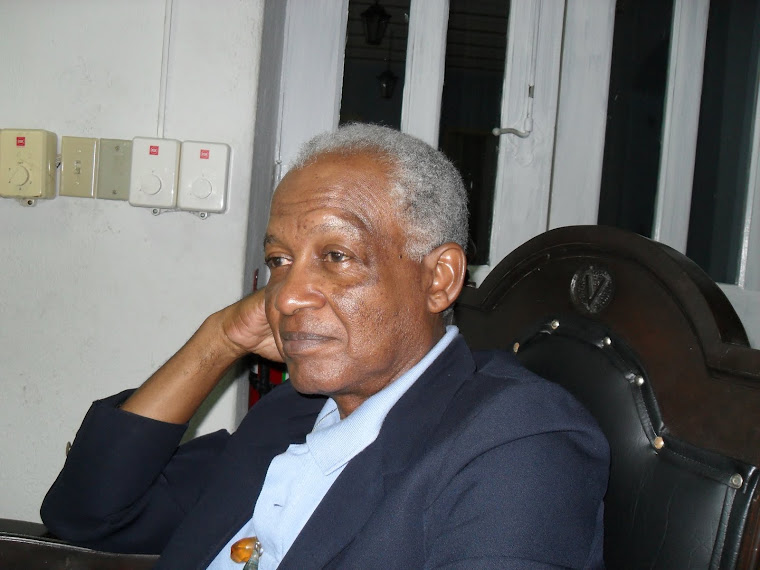
Blas JimenezA friend, translator, scholar and librarian Herbert R., recently sent word of the passing of one of the Dominican Republic's important poets, Blas Jiménez (at left), on November 13. One of the most stalwart expositors and champions of the DR's African heritage--90% of Dominicans have African ancestry, a higher percentage than almost every other country in the Americas except Haiti, Jamaica, and the predominantly Black Caribbean islands--Jiménez had a rich and varied career, as an award-winning journalist; essayist; professor at the Pontificia Universidad Catolica Madre y Maestra; TV producer and host of Página Abierta, radio producer and host of La Mañana en Antena; as Secretary General of the DR's national commission for the United Nations Organization for Education, Culture and Communication (UNESCO). For over a decade he worked at the International Education Resource Center, where he developed courses on Afro-Dominican and Caribbean culture and literature.

Amidst all of this great work, he was also and perhaps best known as a poet, and especially as a "poeta de negritud." His works include the volumes Aqui... Otro Español (Here...Another Spanish), Caribe Africano en Despertar (African Caribbean Waking Up), Exigencias de un Cimarrón (Exigiences of a Maroon), and El Nativo (The Native). With highly regarded scholars Silvio Torres-Saillant and Ramona Hernández, he co-edited the book Desde la Orilla: hacia una nacionalidad sin desalojos (From the Edge: Towards a Nationality Without Evictions). His death, as this very brief note makes clear, is a major loss for Dominican, Caribbean, and African Diasporic literature and culture.

Tuesday, November 10, 2009

Politics + Yankees Win! + Se Pone Blanco + Kessler Lecture, 11/12 + iPhone Drawings

It's been a week since I dropped in here, and every J's Theater reader knows the political business that's occurred since then, so I won't rage. But the results in Maine, which stripped away equal rights and ended Maine's brief experiment with same-sex, i.e., equal marriage, were very disappointing, even though the pre-election polling showed a close contest, and the Roman Catholic Church, among others, poured a great deal of money and energy into overturning the new law. As the chart below (straight from Matthew Yglesias/Think Progress) shows, marriage equality will eventually be part of the American landscape, but it may still be a ways off for most of the country.

Equal Marriage Support in the USA
(Click on table to enlarge)

˚˚˚

On Saturday, the House of Representatives made history by passing a Health Care Reform bill by a 220-215 margin. Only one Republican, Anh Joseph Cao (R-LA), who represents convicted Democrat Bill Jefferson's former New Orleans-area district, voted for the bill, while 39 Democrats, most Conservadems, a few ultraprogressives (Dennis Kucinich) voted against it. The historic legislation, ushered through by Speaker Nancy Pelosi (D-CA) and her leadership team, does include some great touches, such as removing the tax penalty for same-sex domestic partners on the same plan and a considerably weakened public option. It also will go a long way towards covering the majority of the 40+ million who do not have and cannot afford health care insurance. But doesn't allow for a single-payer system, and includes extremist anti-abortion language that could conceivably be used by insurance companies to deny coverage to women who have miscarriages. It also does little to address one of the major problems of US health care, which is we spend more than twice, and in some cases three times what nearly every other industrialized nation does on health care. That is to say, it does little to remove the profit incentive from health care insurance, or to help drive down the cost of pharmaceuticals, medical devices, or hospital care. President Barack Obama removed himself from the discussion several weeks back, and seems concerned only with having something to sign, as opposed to the best bill possible. Or perhaps it's Rahm Emanuel whose conservative pragmatism is guiding the White House's approach. It's hard to know, because the White House sends out so many conflicting signals and operates in such a frustrating passive-aggressive manner it's hard to know what the President and his administration really stand for. Such are vicissitudes of 11 months of Obamatude. Well, we did get Sonia Sotomayor, didn't we?

Now the bill heads to the graveyard of the popular will, the US Senate. Republicans are mostly united against anything approximating reform. The Democrats probably have 50 votes, now that Al Franken is finally seated and Teddy Kennedy's replacement, Paul Kirk, also is present, but the main issue is a cloture vote, and it's unclear whether nominal Democrats like Ben Nelson and Blanche Lincoln, or tantrum-throwing neocons like Joe Lieberman, will sustain a filibuster and prevent anything viable from coming to the floor. The Democrats have one of the wettest noodles leading them, if one can use the term, Harry Reid, who seems incapable of exerting any real power whatsoever. Dick Durbin of Illinois, second in command, seems to do little more than whine and beg, to little effect. It's beyond pathetic. In fact, Reid has even spoken recently of not getting anything to the floor before the end of the year! Meanwhile, the GOP, which is now witnessing its lowest level of voter identification in decades, makes threats, commands the media, and continues to draw stricter and stricter lines, all to the end of gumming up the legislative process and destroying our Hamlettian head of government and state. I'll say this: if the Democrats fail to push through a Senate bill, and if they leave in Bart Stupak's toxic anti-abortion amendment, they very well may have their "Waterloo," even if the President hangs on to middling popularity by the skin under his nails. They appear to want to fail, and they're doing nothing to prevent it. Meanwhile, as has been repeatedly noted, 45,000 people die each year from lack of health care insurance or inadequate coverage, and as someone who dealt with the health care industry extensively last year, I can say that the US's system is seriously screwed up and needs help, immediately.

˚˚˚

Friday I joined hundreds of thousands (a million?) people who crammed into the narrow streets of lower Manhattan to cheer on the New York Yankees, who won their 27th World Series. Responding to an online query, I predicted that the Yankees would win--against the St. Louis Cardinals, who were out after the first round of the playoffs. The Yankees had everything they needed, on the mound and in the field, including some production from the pulchritudinous but perplexing and scandal-plagued Alex Rodriguez for a change. Last year's champions, the Philadelphia Phillies, just could not crack Andy Pettitte or Mariano Rivera, or keep Hideki Matsui and Derek Jeter off the bases. With the Cardinals out, I followed--and watched, sometimes with C--most of the Yankees' games, and thought they'd pull off a 4-1 series in Philly, but the return to and victory in the Bronx only made the victory sweeter.

The parade was, in my experience, one of those rare times, like last November on Michigan Avenue and in Grant Park in Chicago, when vast throngs of people gather together and, because they're united in a common cause, they behave very well. Just a few days before, I'd told C about a near altercation I witnessed on the 5 train, in which a wacko ranted on about everything nearly bursting his rage-swollen head in support of another nut who ran his bicycle wheel over one woman's foot and into another's leg. On Friday, however, and I don't think it was just the presence of enough New York police officers to form a human bridge to Weehawken, people were acting quite kindly towards each other. I saw this again and again as people were polite when pressing through the dense crowds, and on the subway, there were more "Excuse mes" and "Pardon mes" than I've heard over the last 7 months. One unfortunate thought I had amidst all the good cheer, however, was there might be more people in that narrow corner of Manhattan (and in the tunnels beneath and on the other side of the Hudson trying to get there) than voted last Tuesday. (Michael Bloomberg only won by about 50,000 votes, and only 1.1 million of 4 million or so eligible voters cast ballots; I've so far spoken to at least one who didn't.)

Photos and video below:

At the Yankees parade
At the parade (it looks like I was far away, but not really--not!)
Confetti
The confetti being dumped from the cornices--it turned out that some of the celebratory paper included people's vital records and bank documents. Oops!
At Broadway Station
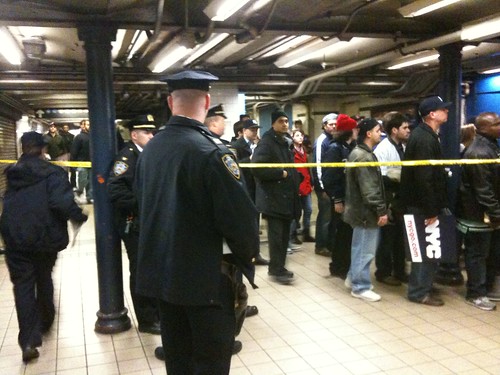
New York's finest penning people in like cattle
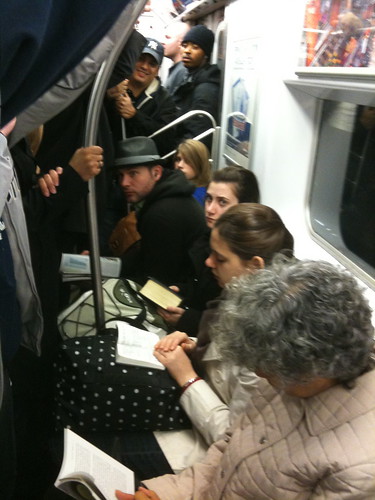
On the horribly crowded 5 train
On a very crowded train--and the young woman in the middle of the photo was diligently reading and speaking her Hebrew text...only in New York!
Yankees fans
Among the many, the proud, the Yankees boosters

˚˚˚
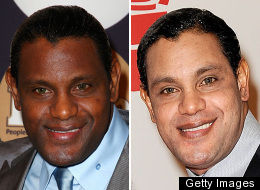
Speaking of baseball, Chicago, blackness, racism, the not-so-proud, and so much more, I'll just present the photos. Ughhh and arrrgghhh. Sad and tragic doesn't barely scratch the surface.

Sammy w/ Mark McGwire
Sammy Whitens Himself

Vitiligo it ain't!

˚˚˚

On Thursday, playwright, novelist and activist Sarah Schulman will deliver the 18th Annual David R. Kessler Lecture. Her talk is entitled "Ties That Bind: Familial Homophobia and Its Consequences."

The event takes place at the CUNY Grad Center, at 34th St. and 5th Avenue, in Manhattan, in the
Proshansky Auditorium. It runs from 6:30 to 8:30.

If you're in New York, don't miss it.

˚˚˚

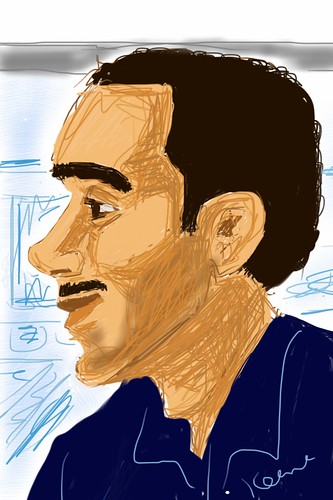
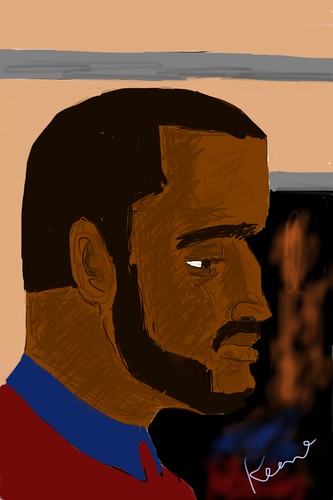
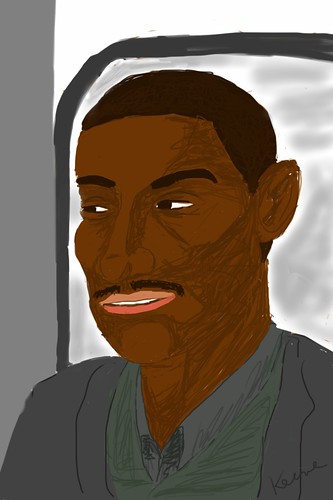
The iPhone drawing continues. I'm addicted. I don't think I've drawn--or thumbed/index-fingered?--this much from life in many years. My new approach is to do as quick a sketch as possible, then fill in the details later. I've also been experimenting with different drawing styles, though I seem to be locked into train portraits these days.

I haven't yet figured out all the intricacies of the very popular Brushes program and have instead been using Autodesk Sketchbook for most of these portraits, which now total 23, or about 1 per day, though some days I do 2-3 in one shot. I do want to learn how to use the layers function in the former app, because I love Jorge Colombo's images.

Now if only AT&T would provide service anywhere near equal to the performance of my iPhone's apps, I'd consider the device essentially miraculous.
iPhone drawing - Young man on train
Man on light rail train
iPhone drawing
Woman on PATH
iPhone drawing - PATH conductor
PATH conductor
iPhone drawing
Man on light rail
iPhone drawing
Man on PATH

Sunday, October 18, 2009

Fire & Ink III Writeup + Natl Bk Award Nominees + Segue + Musik

The weeks are whipping past. Last Sunday at this time I was returning from the amazing Fire & Ink III: Cotillion conference in Austin. I would try to recapitulate it, but I imagine my sentences would continually dissolve into a river of superlatives, which would only be appropriate because it really was a superlative experience. The conference brought together a great number of black LGBTQ and LGBTQ-friendly creative people, from all over the USA and world (Canada, the Caribbean, Africa, Latin America) for three days of conversations and discussions, presentations, and performances. The conference site lists presenters, but there were many more people who came just to see and listen and learn and teach. To be there. I want to thank the organizers once again for the wonderful job they did, from selecting the site itself--the Austin Hilton was great--to how well they organized and scheduled everything, to their patience, friendliness, helpfulness, resourcefulness, and kindness--and for the general ambience they established.

When I was describing the conference before it was held I kept suggesting that it was primarily literary, while its origins and thrust remained literary--and by this I mean literature in all its dimensions--there were filmmakers (and screenings), performers and a large performance (theory) contingent, and social scientists also in the room, expanding the conversation beyond the book and page. What underpinned a great deal of the weekend, and what I found so invigorating, in addition to seeing so many people I hadn't seen in a while and meeting many new ones, was the vibrantly activist tone, but activism in and through the arts, activism in a variety of modes, not just the most commonly understood ones. A review of the panel titles and workshops makes this clear; there was little of the aroma of the cloister I sometimes feel in academe, but instead a deep sense of continuum with the wider world. The stakes for what people have and are doing were quite clear, and we recognized this, even if others often don't.

I was unable to attend the first Fire & Ink conference, so it was particularly and personally important to me to be part of this one. So many strands of my own experience, and not just as a writer and teacher, came together here. There were echoes of the 1980s and 1990s (OutWrite and Black Nations Queer Nations), the various Black Writers Conferences at Medgar Evers College (they included the famous statement by black LGBTQ writers protesting that conference's treatment of LGBTQ writers, books and issues), the biennial National Black Arts Festivals in Atlanta, and the annual Celebrations of Black Writing in Philadelphia, my pre-academe years in the literary world, and my stint, over the last 15 or so years, teaching writing. At the conference were writers whose work I'd been reading for years but had never met, people whom I knew when I published my first stories and poetry, and writers whose work I was learning about for the first time. In much the same way that I felt about the Adfempo conference, I wish I could spend a lot more time, not just a fleeting weekend, with these folks.

My official presentations included a workshop on translating LGBTQ writers, which I made by racing from the airport, and which drew a small and interested group of people. I also organized two panels; the first was on Dialoguing Across the Diaspora, which included Tisa Bryant showing a wonderful clip with interviews on black LGBTQ arts and activism in the UK; Yoruba Richen screening a snippet of a film she worked on about the Sisterhood of the Good Death in Cachoeira, Brazil, and remarks about candomblé and an expansive view of art and activism; and Colin Robinson, who explored some of the ways Trinidadian Calypso has addressed and negotiated same-sexual desire. The other panel I organized focused on publishing today and the new technologies, and each of the panelists, Reggie Harris, Lisa C. Moore, and Steven Fullwood, offered cogent thoughts about the topic, while connecting it to their own work (Reggie as an author, librarian, event programmer, and sage, Lisa as an editor and publisher, and Steven as an author, publisher, librarian, and archivist, all three activists). As with Adfempo, I wish it would have been possible to catch all the concurrent panels, though I did attend many others, including ones on libraries and archiving, scholarship and archives, and the sources of writers' work.

I mentioned the role of performance at this conference, and it included a night of performances. We got to see a portion of Sharon Bridgeforth's play, Delta Dandy, which she is currently continuing to shape as a visitor this quarter (year, I hope) at the university; my colleague E. Patrick Johnson's performance based on his book Sweet Tea: Stories of Black Gay Men in the South, and during the piece he announced that he had been able to resume contact with one of the legendary figures in the book, the 90-year-old from New Orleans, Princess Vivian; and Daniel Alexander Jones's conjuration, as Jomama Jones, with her Sweet Peaches. The conference also included three conversations, under the title "Dash" and curated by artist Torkwase Dyson, that featured 3 pairs of writers and artists in conversation about links and reciprocal influences. The 3 were Tisa and Wura-Natasha Ogunji; Ronaldo V. Wilson and Carl Pope; and Nalo Hopkinson and M. Asli Dukan. Carl and Ronaldo also showed a short video made the night before, featuring Ronaldo at his most limber and liminal, and Dukan screened a clip from her film about Black female vampires that had me and others jonesing for some Grace Jones in Vamp--the full version, though.

All in all, as I tweeted, it was an amazing gathering. One of the videographers, Q, got me on tape rhapsodizing incomprehensibly about the proceedings, so I hope that doesn't appear in the final Fire & Ink Video, but I subscribe to my statements that the three days were soul-raising and that by Sunday, I felt like I and others had grown a set of special F&IIII wings and could take flight. Photos:

Lisa and Steven before the performance
Lisa C. Moore and Steven Fullwood, two of the Fire & Ink III board members and conference organizers, before the performances
Shelagh
Poet Shelagh Patterson
Reggie!
Fire & Ink board member, conference organizer, poet, librarian, programmer, and longtime friend and correspondent Reggie Harris
Tisa & Wura
Tisa and Wura during their conversation at the "Dash" panel
Samiya introducing Nikky
Samiya Bashir, introducing Nikky Finney
State Capitol building
Walking to the event, past the Texas Capitol Building (my friend cartoonist and writer Victor Hodge is the near silhouette)
In the main hallway
In the main hallway, Austin Hilton

***

Congratulations to all this year's National Book Award nominees, and an especial congratulations to this year's poetry nominees! They are:

Rae Armantrout, Versed (Wesleyan University Press)
Ann Lauterbach, Or to Begin Again (Viking Penguin)
Carl Phillips, Speak Low (Farrar, Straus and Giroux)
Lyrae Van Clief-Stefanon, Open Interval (University of Pittsburgh Press)
Keith Waldrop, Transcendental Studies: A Trilogy
(University of California Press)

Like last year's list, this one is really exciting; all five collections are very strong, four of the poets are known for pushing formal conventions, and, on a personal level, Carl and I were in the Dark Room Writers Collective together in the late 1980s, Lyrae and I were in the same Cave Canem group in 1999, and were there together also in 2001, and Keith was one of my favorite colleagues back in 2001-2002. Bravo to all of them, and I would not want to be one of the judges, because all are outstanding poets and most deserving of this year's award.

(H/t Reggie H.)

***

Last night, I had the honor of reading with Keith at the Segue Reading Series, at the Bowery Poetry Club, in New York. Every time I've read there, I have been with excellent company; the last time, I think, I read with the one and only Julie Patton. I read a sliver from the opening chapter of one of the books I've been working on, while Keith read from his nominated volume and several others, including his translations of Baudelaire's Paris Spleen. Our readings eventually be on Penn Sound's website, so when that occurs, I'll post it on here. My thanks to E. Tracy Grinnell and Laura Sims for inviting me, pairing me with Keith, and bringing people out!

I should add that before the reading, I got to meet a J's Theater reader, Joyce Russell (I hope I remembered your name correctly!), a Canadian poet who'd read with a group of other Canadian poets at the Bowery Poetry Club before the Segue Reading, and who was chatting with Djola Branner, one of the performers at Fire & Ink and a founder and former member of the groundbreaking Pomo Afro Homos troupe of the late 1980s and 1990s. (I still have my tattered PAH t-shirt and refuse to throw it out.) I'm sorry I missed Joyce and the other poets who read before us, but thank you for reading the blog, and maybe we'll get to read together one of these days down the road.

***

I haven't been listening to as much music as I sometimes do, especially during the winter--I blame Twitter!--when I'm in the car more, but here's my most recent fave playlist, stretched across 5-6 actual playlists on my iPhone (I have not used my iPod in over a year now).

Bebel Gilberto, "Bring Back the Love" (Brazilian Girls Extended Mix)
The Black Eyed Peas, "Meet Me Halfway"
Chrisette Michele featuring Ne-Yo, "What You Do"
Common, "What A World"
Franz Ferdinand, "What She Came For" (Drums of Death Remix)
Janet Jackson, "Make Me"
Jay-Z feat. Rihanna, "Run This Town"
Massive Attack, "Splitting The Atom"
Michael Daugherty, "Sunset Strip"
Miti Miti, "En Los Noventa"
Os Mutantes, "A Minha Menina"
Portishead, "Glory Box"
Q-Tip feat. Norah Jones, "Life Is Better"