I thus voke thy aid
to my adventurous song,
what are "poetics," what
is poetry? Is it
"segmentivity" or "the news
that stays news," is it central
to the nervous system
of poetics? Between
Columbia and Penn
a poetics conference, con-
versations begun
by Golston and Perelman,
(and Bernstein, behind them,
in minds, so many here,
and elsewhere, inspirited
with memories and ideas
of Leslie Scalapino, Cage,
Wittgenstein, Emerson,
Dickinson, et. al.),
three days, in Philosophy
ten panels, many panelists:
scholars, critics, poets; 41,
none Asian-Americans
if you're counting. Who counts
haunted the proceedings.
Who counts, in or outside
the proceedings, in or out-
side academe, institutions,
aaaarg.org, outside or in Silli-
man's or the Poetry Foundation's
blogs, the journals, net-
works and coteries,
the batteries of chapbooks
and books the oral and dissertation
writers and committees
might be reading, thinking
about and rethinking,
this rethinking and defining, amidst a ghost
horizon of privilege and invisibilities
framing the conversations'
often radiant, expanded fields.
What counts, as poetry, in
poetry, as poetics: relating to the art
of poetry, of making (poetiké, fr.
Gk. poiein) objects,
cf. Aristotle. Accountings:
poetic composition, tools
and materials, history
(but not materialist history per se),
tradition, relation (mostly tradition
of the European kind),
globalism and hybridity (mostly US,
i.e. "us" (we? who are ____), mostly
form), social location and ethics
(grazie Rachel Blau DuPlessis
and Joan Retallack especially),
poetics and the Academy
(which counts most, perhaps,
among most of the attendees), ecologies
of poetry, poetics as a category,
affective economies and prosodies
(but mostly affect as a concept,
so powerful, contemporary),
the end of authentic time and
reading radicalism came after
my attendance ended, on Sunday,
though PennSound was listening
continuously, so the presentations,
challenges, arguments, vocal antagonisms
and their responses--"fuckface"--will be--
"fuckface"--available--"fuckface"--
to the world. So what is or are poetics,
our poetics, and does poetry matter, do poetries
other than the Euro-American
matter, other Others' poetries
matter, and are there poets
not in academe, not critic-theorists,
not doctoral students or soon to be doctoral
students dissertating, who do? They do. Where
were the writers and students
from the School of the Arts
creative writing department but
three blocks north, Perloff asked,
and is creative writing--poetry--
valid, relevant, connected directly
to this thinking, rethinking
an entity (a system
of institutions, a discourse,
a field, expanded),
this poetry that still holds
considerable capital
(Bourdieu), a high place
in the social (if not economic)
imaginary and hierarchy
(publishing, Epstein, Schiffrin, unmentioned),
that some might be seeking then
by rethinking to destroy?
Is it true that most people hate
poetry? Is it true that most
find it difficult, even beyond
the neoliberal prisonhouse
of university classrooms?
Do most people really think of it
when they think of it at all
in relation only to greeting cards
or else inaugural poets
and poems, like some serious
and bitter medicine lacking even
that sickly-sweet cherry flavoring
that starts to taste good when you're
really sick rather than listening to it
daily in songs, hiphop, rock, pop (so far
as I can recall, never uttered, not once,
not even the touchstone Gods
Dylan-Elvis-Leonard Cohen),
in speech, in backs-and-forths,
writing it in journals, on blogs, to loved
ones, reciting it to impress or beguile
or as acts of resistance, eagerly
returning to poets dead and living
who were not mentioned and wouldn't be
mentioned within a mile
of these sometimes exceptional panels?
Whither music, dance, and related
arts? Must poetry be lineated
as this pseudo-poem report is,
rhythmic, prosodic, metrical (not
that word!), use repetitions at all?
(Oh conceptual poetry, writing,
horribile dictu, you and Flarf
burbling up through the drains
of contemporary writing
and causing great anxiety,
delight, joy, annoyance, fright,
confusion, dismissal, because of your refusal
to fit within unstable confines.)
Brent Edwards spoke of Hemphill
(Julius), Tonya Foster of Sarah Vaughan
(and scat and the scatalogical), but
music was only an echo, a trace
amidst the talking (no singing, scatting),
a solo in this hive of dreaming out loud
and hard, hard thinking into being
(the archive of) an archive.
Oh, there is a blessing in this drizzly breeze
that carries the questions, What counts, who counts
what is poetry, what poetics might be
in an age of ever-developing technologies,
what of books too in this digital
age, our dematerialized present, virtual presences,
the vast and powerful neoliberal "software"
we're all running on, whose air we breathe in
every hour of every day? What of books
and what of collaborations, poetics whose ecologies
encompass other disciplines, landfills, oil spills,
wars metaphorical and literal, embodied as dancers,
publics imagined or not yet imagined,
politics imagined or not yet imagined,
archives imagined or not yet imagined,
poetries becoming "something else," counter-
speculation, material disintegration, waste (shit
and its residues), news, new or old, the impure
products of America (Williams another angel
omnipresent, edifying), all gathered together,
breaking apart (fragments, ruins, the specter
of Modernism and post-modernisms), the oral
and the written, discursivities, "choral."
Can poetry look outside itself?
Can we look outside ourselves, collectively?
Can we look outside the neoliberal, collectively?
Can we look outside the human, collectively?
Can we look outside the windows of the packed room,
past the panes to the concrete, the park and its steep
drop down Morningside Heights to the 116th Street
pavements I crossed to enter on Saturday?
Are we looking outside the comfort-
able confines of the pack,
the alphas and betas setting the pace,
do we see the other faces, the others' faces,
the other poet faces, other poetics facing these,
as we (who?) peer closely at and rethink
our (whose?) own? Who owns these poetics,
these poetries? Who remains invisible
and illegible even after the curtain parts?
Can these poetries and poetics be musical in the absence
of music or discussion of music, can they be or
become ontologically plural and is it ethical if there's not even
an active peeking and looking beyond those panes,
is that poethical if there's peaking beyond and none
here see it or hear it? Brent spoke of Ellington,
parallels, proliferations, concretions, can you hear
it, them? Do you listen? Aware, but you care?
"Everything we see could also be otherwise" (Wittgenstein),
other whys (Baraka): Bernstein's pataqueeranormal, -normative,
his "swerve" and "adversive" ("mental fright"),
his "derangement of the senses" (Rimbaud), his "strange,"
his "swish," and "sissy," but to a swish, a sissy, a queer,
this one here who asks with "sincerity" (Reznikoff, via Zukofsky),
is he really listening, aware yes, sure, sitting there, swerving
there, but what are the manifestations of that care? Show me.
Scalapino: "The human is crisis." (Ghost traces.)
In here poetry is in crisis, poetics are in crisis; out there?
Out there poetries are in crisis, poetics are
and....we are for ontological pluralisms (Erica Hunt), we are.
"One world, many minds" (Hunt) Many minds,
so much cleverness, so little time (Clever Clover
and the landmine of the mouth). Is poetics
a limiting frame? Is poetics in friction
with innovation, does it do the not-Princeton rub
with experimentation? Thinking past the limits
(historical and empirical with figural-Edwards), over there
is where the parallels lie.
Ambitious unknowns, collectively sigh
no more sadly. That is where the lie
parallels the--no Plato, long since buried,
under the unspoken green Greek swards
with Socrates or in some other archive.
Collectivity: what is poetry, we ask you?
Collectivity: poetics? Collect-
ivity: how many times can and must we seek
of an archive? Can and must we not speak of the archives?
Whose? Collectivity: can you answer me
without recourse only to the great master
minds and archives of Europe? One world,
so many minds but all from one historicultural mental massing.
Collectivity: are there verbs to express this kind of thinking?
Don't noun, verb. Don't image, think. Don't look, write.
Don't don't, act. Collectivity: what and where are the answers?
Collectivity: are we not always speaking of the body, of bodies,
ours and others? Collectivity--poetry: image: action:
(Laocoön, with Lessing unmentioned as well).
Collectivity: are aesthetics a superseded category, too
limiting to the field of poetics, its possibilities?
Dead as deconstruction, psychoanalytic theories, post-
colonialities, the new historicisms, the new new post-new?
Collectivity: to get beyond the boundaries set by neoliberalism
and its traps, to puncture the market master magus,
the page, or stage, or dais, to enter the frays
of the digital--this is ethical, we are together in this,
at least some of us, in here, whether we see us
or not, we see US or not, a "we" (or not).
Is there a spark, collectivity, and what is its verb?
What lights, illuminations, fires--what's motive?
Choral crowds, genres for action, verbing and swerving
into the now thing, the now-thinking, thinking now
as it enters and blossoms into something, landscape, harbor,
haven, abatgis, slip, hammock, arbor, slope,
sleep, hammer, keyboard, labor, affect, archive,
hope or some other abstraction, the we
in here, inhering, the we of poetry, poetics,
the whee, way, wee pluralizing, waxing
poetic is a form of knowledge-making,
making and taking back the forms
of knowledge, the possibilities,
rhapsodizing, of pleasure, poetics' and others,
that we're phreaking as we're seeing
and speaking thinking, and wreaking
writing: one world, many
minds (Hunt): many worlds,
many mimes: any worlds,
many memes, reres publicae: poetry.
Whose making all that racket
in the archive? Poetics.
Who's making all that racket
in the traditions? Poetics.
In the archives, poetries
or the traditions of poetics,
traditions temporationally, not spatially,
alternatives, to join, though who's
this we making all this racket
and not even leaving
testimony to the eyelands
beginning to appear,
and are we--we?--spatially
in there? Debriscapes, extrascapes,
countertraditions, are they ours
and are we in there? Are you? Nudge,
engage, be against, to be again, to gain
access to, think through. Ante, up, anti.
Anti-interpretive, an "erotics" of...stop/ /bogging,
start telling the joke without its form, scatting
performative rather than definitive spaces.
Scattering, reconfiguring, transfiguring,
in the silences
within silences.
A baratadeeboppaluquivadoop: phatic.
A da daadaaa deeet deeetdeet
dum diddlysquatalicious--phatic.
Get phat, got that? Trawl Jakobson, Abrams.
Shudder, utter, stagger, stutter, still. Troll
the airwaves, fill them. Flarf dem
um, uh, duh, da, doobie, okey dokey, fort-da, say what?
Phatic, haptic, knowwhatimsaying yo?
Get back, for real, fo sho, daswassup, say what, Son?
You alright, stay around, almost mellow, One...Say,
our "boats are open." (Glissant) Say, the multiple
consciousness (nope, no dope DuBois). Say Césaire
and Baudelaire, "more at stake than aesthetics,"
the beautiful, the true, the sublime, disinterested, purposive,
Aufhebung, the autonomous, the aestheticist,
the historicist, the Dionysian and Appollonian, the high
and low and mid-brow, the is it art or is it not or it is
what I say it is, the public coefficient, the aleatory, the Ou-
LiPolean, the formal or formalist, the depersonalized,
the post-aestheticized, the desiring machined, the it-is-there,
the all of that glowering history, his-story.
This is a confab about poetics (and poetry).
Say dehistoricize and rehistoricize (Willis), push poetry up
against those other works, get it popping, into all that biz it's walking into, talking its way into, stammering and shimmying its way to, this important political labor that people are doing and all of sudden it's become this other thing, a political creature with some power in its having no public power at all, so how do you talk about it, yes you, the poet or critic or poet-critic or academic or whatever you fashion yourself as, coming back to this idea and your archive-praxis, knowing that "all you can do is suddenly listen?" (Cage). Poetry, are we into it? Is it into us? Do we mind it, truly, really? Is it not the basis, or one, for memory, no matter what psychologies and biologies may tell us? So I'm sitting at this seminar at the university, this is a month or so back, and we get into this back-and-forth about some theoretical issue, and my colleague, a poet, fiction writer, essayist, translator, scholar, all these things in the same body, tries to bring the discussion back to the language itself, the language of the poems, and I say, it can be both+and, which is at times a problematic formulation, but this came up again at this conversation, in a conversation, around oppositionality, because there's inclusivity as well, "discursive inclusivity," though the language of the poem, our languages and how we use them, shouldn't be forgotten. Are we in them, poetries, poetics? Once upon a time a great deal of poetry was published for children and adults read it, adults memorized it, my grandparents did, my parents did, there were all these collective forms and forums, form as a collectivity, hymns, worksongs, music (popular), how did we forget all this? Say, how is it we don't look outside the window most of the time, poetries, poetics?
And this is very sooth that I tell you...radical particularities...the SF language school of the...1970s...not everybody was Kung-Fu fighting...some were talking and writing at the Grand Piano...some (the dazzling Mónica de la Torre) were talking of some talking and writing in the 1920s in São Paulo, Paulicéia Desvairada!...some were talking and writing about those Andrades, Miss São Paulo and the other one, not related...some were talking and writing about the Brazilian manifesto (Modernism--open to the world) and the Cannibal manifesto (closing up shop, a self-devouring)...some were talking about Haroldo de Campos and concrete poetry, how exportable it is, the image prevailing over the text (think Smart vs. Campion)...eye over ear...some were talking and writing about how "the longing for modernity led the poets to abstract the location of the future" (so beautiful, a truly poetic thought)...some were talking (and citing Roberto Schwartz) about how de Campos by 1963 had gone onto another project, the Galáxios, known in Brazil and Latin America but not on English tongues...some were talking suddenly in Spanish about the neobarroco and la poesía conceptual y pues porque no dejó de hablar en español many people perhaps didn't understand...and some were asking questions like, what might poetry for export be?...and what might the goal of extending a poetics to include globalisms?...and are you a filterer, relater, or rehearser, poetries and poetics...and it was good to hear about poetries and poetics outside of the Euro-American matrix...because those other poetries exist, those poetics exist...not cut off from the EA matrix but also not totally dependent upon them...they exist, we exist...and them someone was talking about antagonisms and "American hybridity" meaning formal hybridities of a very specific kind and that led to a blowup during the Q&A...that antagonism and blow were wake-up calls...there was the poetry of the expanded field...the charts that lured my eyes like sirens...Smithson, the jetty, the not-sculpture, not-language, the Klein square (not bottle), poetics, the not-poetry...making me think as I type this, am I still writing a poem?...is there segmentivity and rhythm here...repetition...rhyme...how would I describe the poetics of this elliptical passage...ellipsis being a technique and rhetorical figure...and Butler having returned us in the 1990s to the importance of the rhetorical, the gestural, as against the structural, the linguistic (Nealon)...how would and could you speak of the poetics...the poetry...here and now...
Of hermit saints, these words addressed,
much more they said, so many pages I filled,
cursive upon cursive, line by line,
about genre (social) and form (individual),
about Derrida, the negative, social
and ethical locations, about absences
that Blau DuPlessis elegantly touched upon,
ethnicity (RACE?), class, gender (SEXUALITIES?),
disabilities, economics, social positions,
sediments and sedimentation,
memories' traces in the identifications
we daily live and perform,
the scripts and texts we carry
around inside us, imagi-nations,
Toscano's "material
translocative carnicities,"
evidence of things not seen
but discussed, reviewed,
on location, in location,
ego and echo (-location),
Lo: Poetry, said Joan
Retallack, "is a form
of courage," the microclimates
of our poetries affecting
and effecting the larger climates
of our world (Cage),
this necessity, always,
for reciprocal alterity,
alterities this courage,
created by poetry,
this ethical necessity
of relationality,
in Chang (videoing Hughes)
and Tolson, this need
of and for "soul," the word
SOUL, thinking about
the between,
a "textual structure
of feeling," older forms,
vulnerabilities,
rhyme, rhythms
going back
to that black place
--poetries, poetics,
do you hear me,
do you read me,
over and out?
((Freemasonrywise)
I missed it--Delays!--Escarpments!--
Those light-rail tracks and subways
of dishonor!
The panelists' disquisitions
on poetics and the academy,
there is no terminal on the molehill
of ambitions...the most important panel
of the morn....Spahr, Novak, Giscombe,
Evans, Young...at lunch D spelled me....
you start out as a peon and maybe be-
come a classroom star...
Oh, how to think beyond the architecture
of the private or semi-public institution...
Spahr: how to (re)create the kinds
of associations and organizations that existed
not so long ago, the disappearing independents,
journals, zines, collectives (cf. the Dark Room)
that arose outside and beyond
the universities' doors?
Is that outside out there any more? (Yes.)
Is the only desire now to gain entry? (No.)
--Creating those open spaces that defy
the boundaries, the rules, the private, and capital.
That resist the overwhelming neoliberal vacuum.
You began a schoolgirl and now wield your PhD.
You are armed with knowledge but you are not free.
Giscombe avowed teaching writing, creative
writing, taking field trips, leaving to see,
to learn, to come to know in the out-there, the otherwheres.
But what about hierarchies, prestige, the a priori
power of certain names and the potencies they claim,
these institutions and their social capital, their demesnes?
What about the wolfish logic (the genius
of capitalism--Paul O'Neill) that devours us,
poetry too, that makes a college ed and gig necessities
for so many?--Not all are rich, not all entitled,
so few can say I want to write all day or even part of each day
and someone will pay my rent, utilities, clothe me, feed me.
--Even the idea of the open university is a threat here.
--Even the idea of the non-academic is a threat here.
Does this stifle poetry, suffocate it? What would a poetics
of the socially, economically and politically open
sound like, look like, feel like, taste like?
What would a poetics of freedom, a free poetics look like?
We would know it when we were in it, wore it,
wrote into it, would we want it?
BD spoke of cross-university
partnerships, outside registrars,
she and Perelman Penn and Temple,
what the students gained in access,
but what about those not in their classes?
Is there a public forum by which these ideas
can circulate, the poems can circulate, the poets
connect? Is there a public poetic sphere,
not about power and privilege,
reputation making and breaking, the great
men and women, lettering and rubberstamping,
where poets and poetics can
even uneasily set camp?
Write the secret sign, and make it available...
write the open sign, and free it: poetry.)
And went down and rode in a hole
in the ground. To Jersey. And then went up
and climbed a mountain in Harlem.
Saw Schurz, back to the living city,
bronze profile helming the promontory.
Families moving about as embodied poetry.
Asphalted history snaking beneath me.
Three streets, two hills, back in Philosophy.
So different from the spaces Bitsui comes from.
The places a few of my ancestors knew.
Where words still bore their sacred force.
Where capitalism had not yet snowed
over the hard terrain. Where hot rain fell
into the estuaries as they sailed them,
worked them, their own or some others'
dying fields, the blue/black ceilings or skies
repeatedly raised by their plaintive blues: poetry.
What is the message within the message?
What is the message beyond itself?
Occasionally, like yesterday or today
I am permitted to enter, at a premium, a message
like a meadow that doesn't feel mine,
mean or indifferent, at least, where I stumble
and sputter and listen and linger,
where longing pervades me and I spend a long time.
What is the message of the message?
What passes through the meadows
that are not truly ours? Poetry.
Watten: nature's importance "as a site of the not-me."
What do you mean when you tell me
of ecology and poetry?
What is poetic ecology, or an ecology
of poetry? What is an ecological poetics
or ecopoethics, and where does it take us?
Bitsui: these lands, my people's,
are now turning to dust.
Ecologies require multiple
ways and acts of seeing.
Ecopoethics require human trust
in the nonhuman.
Not reducible to a single form.
Sometimes silence is better than doing harm.
Sometimes silence is the way to go.
Sometimes silence carries the power of a charm.
Sometimes in that silence you come to know.
Voyage through death
to life upon these poetic shores,
but does this even address
unending questions of categories?
Why, Dworkin queries,
the category of "poetry" at all?
Why are the other categories
so given to parsimony?
Why pitch your freaky tent
in front of this particular stall?
Why's poetry always stirring
up so much damned trouble?
In the center of the ring,
fists raised, ready to rumble?
Denken ist dichten, or should be
a form of therapy--but not poetry!
Golding: "the production
of poetry and its consumption."
Don't all roads return us
ultimately to this issue
of commodification?
No no no no no no no!
Future anteriors, becoming
the person one is,
the "authentic poetic project,"
pace Dorothea Lasky (where was she?).
Hofer resurrected Aram Saroyan.
Thank you. Voyage through death
to life, or "lighght," as AS
had it, Duncan chose it.
"Minima," "spareness,"
and as Emerson proposes it,
"every word was once a poem,
every word is a new relation."
Pound: "Rhythm is a form cut into time."
Saroyan: "Consonants govern pacing."
Pound: the poem debunks
"by lucidity." LIGHGHT.
Has one come on? Many?
Because we are back to forms
cut into time, to poetry. Perloff:
the public, what's a poem,
Maya Angelou at the podium,
riffing for Clinton (which became
a House song I heard and danced
to--"a Rock, a River, a Tree"--at the Delta Elite,
--"you, Pawnee, Apache, Seneca, you
Cherokee Nation"--but I doubt Perloff,
who knows so very much has ever heard that),
poetry, etc. But really it's all
about poetry. The poem. Place,
Vanessa, Statement of Fact,
sexual crimes, etc. But really it's all about
poetry. More Vanessa Place, career,
fiction, one subgroup but the wrong
one, blurb, what do we call it,
sexually contentious, etc. Poetry.
Goldsmith's (not present)
Traffic "is poetry." Fitterman
UbuWeb Dworkin and Goldsmith's
anthology from Northwestern,
etc. BUT REALLY IT'S ALL
ABOUT POETRY!
A fuzziness today, but...
Clover: prestige, kids know it
it when they spot someone with flow
in basketball, on TV, in movies--
poetic vs. prosaic, no body
wants to be a vast flat lot or lumpy plot
of words and text and movement,
but wants that lyric swagger: poetry.
"Is there a desire to undermine
or destabilize this?"
Perloff: "That which is written
in the language of information
but not in the language game
of giving information,"
i.e., Wittgenstein. Word.
Jakobson said: "poeticity"; Blau DuPlessis:
"chosen segmentivity," "rhythmic
segmentivity," that's poetry.
But really it's all about the poetry,
or should be, according to Marjorie,
lose not sight of that,
as pretty and shiny and exciting
as theory and criticism
and cultural studies and psych
and anthro and socio
and performo and bio and neuro
all are ("hairy star turning
under water"--BD). Po-e-try.
Some hour, in the emergence from this fierce insight,
let me sing--because that was once the source of this gift--
jubilation and praise to the assenting or dissenting angels.
Not real or better angels but people who think deeply,
seriously about affective economies. They may or may not
be poets. They mostly have academic jobs and are very smart.
They know their Derrida like seminarians know the Bible.
And Foucault because he's still important, and Benjamin,
and Deleuze and Guattari, and Butler, and Sedgwick,
and Leo Bersani, with panache and despite the difficulty.
(Once I spent a week trying to figure out
the argument in Bersani's "Is the Rectum a Grave?"
which I pursued because the title intrigued me so.
But that's neither here nor there and I finally untangled
Bersani's argument, or at least convinced myself I did.
It took me longer to grasp Lacan's "Kant with Sade,"
but there's revelation in persistence. Most
of the time, IMHO.) Thence: affect queer theory
before queer theory 1990s affect Butler Bersani
plus a short graphic sexual passage, involving
male-male sex, penis and ass--Nealon. Brilliant.
Williams (Raymond), Structures of Feeling,
affect, neoliberalism, Zukofsky on Reznikoff's
"sincerity,"Peck and Tickle, neoliberalism
as a "software," Harvey, Lefebvre, Ahmed,
neoliberalism, market/structure of capitalism,
sincerity, "of word to thing," to the social,
"sincerity is a software that would allow other forms
of sociability into the poem," still thinking about
what that would look like (the poetry)--Derksen.
Brilliant. "There is a third path and that
is the one we're going to take."
(Shklovsky) and much about
the problems of witnessing
in an encantatory performance.
--Zolf. As always (cf. Adfempo),
super brilliant. Then the much-heralded
Lisa Robertson, who spoke
on M. Henri Meschonnic,
a figure needing to be
translated, prodigious,
who passed last year,
his poetry and theories
and terms so vital,
but also running counter
to the terms so widespread
in the contemporary
American experimental
poetic communities;
pour M. Meschonnic
le truc c'est rhythm
"as a social force
via prosody"--so
many good quotes,
including "the active ethic
of this listening
for which a politics
comes" and "motility,"
and "the poem is
the critique
of the sign,"
his critique
of l'écriture et
les pages blanc
and il y avait tant plus...
until in the Q&A
Golston notes
that he wrote about Meschonnic
in his first book, pointing
to the French figure's
intellectual genealogy
that includes Klages
(a raging anti-Semite)
and Jacques-Dalcroze
(Mr. Eurythmics,
who also believed
rhythm could be a "moral
hygiene" and the basis
for a "new society)," etc.
Questions ensued
and not a lot of answers
and we, who think
of ascending joy,
would feel the emotion,
yet that's not what
all this work on affect
is really about,
that almost dismays
as much as our anxieties
about poetry and activism,
or rather poetics
and activism, though
for some poets
and activists, like those
at Split This Rock,
who were nowhere near
this event, this tension
unfolds as central
to their praxis,
if I'm using the terms
of art correctly,
but nevertheless
these are very smart
people who are training
others through their gifts,
and writing about writing,
and writing, and perhaps
not feeling dismay
or the stultifying angels
of tradition or neoliberalism
or of poetry itself,
when it, a joyful thing
at times, at others
utterly terrifying, into
their laps or laptops
or books or minds
or mine or anyone's,
like this longish
report--I thus invoke
your aid itself
a kind of poetics--
slowly and
inexorably falls.
Copyright © John Keene, 2010
Showing posts with label poetics. Show all posts
Sunday, June 13, 2010
Saturday, September 26, 2009
Adfempo Conference @ CUNY Grad Center + Dangerous Mathematicians Show
What an exciting, energizing two days the Advancing Feminist Poetics and Activism: A Gathering conference was. I must offer my heartiest thanks to Belladonna, the independent bookstore/publisher/collectives, who conceived, organized and executed the event, along with the CUNY Graduate Center’s Center for the Humanities, Center for the Study of Women and Society, PhD Program in English, and Poetics Group. There was such palpable intellectual and creative energy at the event, which explored and emphasized the necessity and possibilities of feminist poetics and activism today. I didn't attend a single uninteresting panel or reading during the event. It was also wonderful to see so many creative people--brilliant, visionary, socially and politically activist women in the poetry world!--I know and admire as well as those I've never met or seen but only read over the years. My only complaint arises from the concurrent scheduling situation; because of the multiple simultaneous panels, it was not possible to audit most of the intriguing discussions, and if you jumped from room to room (there were 4 panels per time slot for most of Friday) you very well might miss the people you were hoping to see. I do understand, however, the economic and logical necessities of fitting the event into two short days, so I'm looking forward to the videos of the panels, when those go online.
I also want to thank poet-scholar-activist Tonya Foster, a member of Belladonna's Collective Committee and the organizer of the panel I was on, which, as the Opening Plenary I panel, inaugurated the event on Thursday afternoon. Our panel had grown out of discussions we'd been having over a series of months, and focused on orality and literacy in relation to African American and Diasporic literature, but also had come to encompass discussions of "the commons," and in particular, the "feminist commons." Other panelists included Meta DuEwa Jones, who spoke about Erica Hunt and Tracie Morris; Evie Shockley, who talked about Sonia Sanchez's Do These Houses Have Lions?; and Julie Patton, who showed slides and discussed her creative, activist work with young people in Cleveland, as well as her mother's artwork. We ended up running short of time, and I went last, so my talk, discussing Kamau Brathwaite's, Jay Wright's and Marilene Felinto's strategies for utilizing orality and feminist-inflected oral and written discourses (historical, mythic, etc.) to subvert conceptions of aesthetic mastery, was smushed into pithiness, but I do feel like I did succeed in getting my points across. And I got to read a translated (though not by me) snippet of Felinto's work, so that was fun too.
Our panel was packed, as were most of the ones I attended, despite their concurrency; at the 12:45pm discussion on the "Body and Discourse," chaired by Kate Eichhorn and featuring Joan Retallack, Trish Salah, Laura Smith, Nathalie Stephens/Nathanaël, and Ronaldo V. Wilson, there wasn't even standing room for most of those present. This panel, like the others I attended, delved into the questions that people had been posing and hashing since our opening presentations, and involved some contention and argumentation, rather than an amen chorus, which was refreshing.
Two of my favorite moments at the conference were the Thursday night keynote talks-performances, and a reading, introduced by scholar-poet Kate Hinton, that Mei-Mei Berssenbruegge and Ann Lauterbach gave on Friday. At the former, Kathleen Fraser talked about her trajectory from newly-minted English major just arriving in a very male-dominated New York poetry world in the early 1960s to her move to California, her years of young motherhood, and her connections with some of the figures who would become so important for developments in feminist poetics and practice/praxis. Amidst this she wove in some unforgettable anecdotes, such as that Barbara Guest was the only female poet whose work she came into contact with in those earliest years, outside of the "modernist women," that Charles Olson was huge, dominating figure and not the sort of person for women to be alone with, and that George Oppen was a serious, but encouraging poet. Fraser concluded her comments by reading a moving pamphlet-long poem, whose title I wrote down as "hi dde violent i dde violet," that she had written for fellow poet Norma Cole. Erica Hunt, a writer and thinker I admire tremendously, followed and in a way only she could do, she managed to weave in a demonstration of her mother blind-folded and boxing to discuss the feminist projects feminist poets had engaged in and needed to continue to pursue, especially in light of the economic, social and political situation we all now find ourselves in, and which has been unfolding since Erica and the other writers in the auditorium began their work. She was sharp, witty, oppositional, elliptical, concise, and offered up a series of grace quotes. "We write what just might escape commodification" is but one of them.
The third speaker, Eileen Myles, gave a talk called "Yoga for Losers" which succeeded not only in reminding everyone that the "academy was a patron" and a fraught place and space for the poet's work, but also called out the Language poets, asking where was the great language poem on AIDS, and wondered whether the model of "schools" of poetry was less apt that "stores," decried the pervasiveness of pornography for girls' and boys' imaginaries, invoked some contemporary women writers doing what she thought was outstanding activist work, and even expressed her exhausting with the term "feminism," ultimately urging that the hard work continue, in a range of new forms. As more and more poets (and writers in general!) appear to view the academy as the route, as opposed to one of many, or even just a byway, to pursuing an avocation as poet, Myles's critiques assume even greater importance.
The Berssenbruegge-Lauterbach reading was also a highlight. I have seen both read a number of times; Berssenbruegge was one of the first of the younger generation "experimental" American poets (not counting some fellow students) I heard read and met in college, and she came to the university a few years ago as part of the Asian American Studies program's 10-year anniversary celebration. I had an account of Lauterbach and John Ashbery reading from the latter's long, double-columned "A Litany" at the Bowery Poetry Club a few years ago. This was the first time I'd seen them read together, and with the focus being on their art-inflected poems, they complemented each other perfectly. Berssenbruegge read from her collected volume I Love Artists (Univ. of California Press, 2008), which really should have received one of the major poetry awards, as well as from some new poems. Her quiet manner and soft voice require the listener's concentration, which the poems thoroughly reward. She also read lines and fragments from others, something poets never really do, in order to convey the spirit of the reading. Some of the fragments of lines I wrote down from the various poems were: "there are three dimensions of gray"..."your waking is a blue brushstroke creating a space"..."this color of being sentient, like seeing Venus in the day"..."where openness is form"..."but I am my contact with green"..."forest is the originary fullness of this presence"..."you turn back my words to stay in that region."
Lauterbach, whose work I believe always benefits from being read aloud, especially by her, traced her poetic development in relation to visual art, which has served as a formal rather than a visual source. She noted the centrality of the visual to most poetry, and her own attraction to resistance against or inquisition of the visual. She also read poems marking her stages of confronting the visual, including the first she'd written, some time ago, in which there was no visual description whatsoever. One of the poems she read, "The French Girl" (from Clamor?) struck like a lightning bolt this time. She finished with the poem "The Scale of Restless Things (Fra Angelica)," written after going to see that exhibit at the Met with a former student, Garrett Kalleberg, and it was a fitting conclusion to a great reading. Afterwards she and Berssenbruegge, along with Hinton, took questions, and Lauterbach provided one of the most succinct and thoughtful responses possible to the question of how to appreciate a poem, particular poems like hers, explaining how a poem is an experience that we ought enter like any other experiences we've never had, and how it negotiates the parallel subjectivities of the reader's I and the lyric/narrative voice's (I/we/multiples). That space of negotiation ought be fruitful and pleasurable, rather than merely a puzzle to be interpreted and solved.

Erica Kaufman and Rachel Levitsky

L-r: Evie Shockley (back turned), Julie Patton, and Tonya Foster

Kathleen Fraser, reading her poem to Norma Cole

Ronaldo V. Wilson (in tie), speaking to the panel (l-r): Nathaniel, Trish Salah, Joan Retallack, and Laura Smith (who spoke about Akilah Oliver)
***
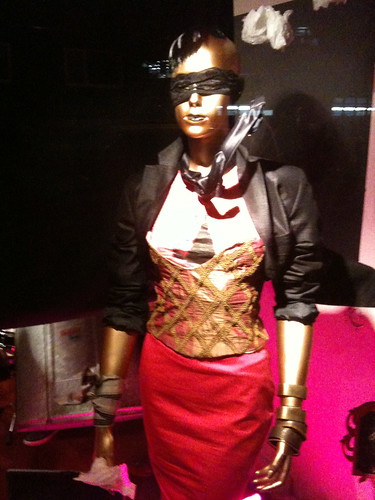
After I left my dinner companions on Friday, I took up a friend's invitation to check out a fashion show/performance party, Dangerous Equations 101, at a small shop, Dangerous Mathematicians, on the Lower East Side. Unlike this events at Bryant Park a week ago, this was a low-key, non-industry affair; the shop's owner creates and sells innovative, sexy clothing for women with a geek chic edge. The "models" turned out to be practicing engineers, scientists and mathematicians and the clothing had a S&M-ish edge, which I doubt would probably go over better during the weekend or at clubs than at most workplaces. It appeared to be well-made, and really, the funnest aspect was just listening to the musicians and seeing another slice of New York I seldom see.

Dangerous Mathematicians store window
I also want to thank poet-scholar-activist Tonya Foster, a member of Belladonna's Collective Committee and the organizer of the panel I was on, which, as the Opening Plenary I panel, inaugurated the event on Thursday afternoon. Our panel had grown out of discussions we'd been having over a series of months, and focused on orality and literacy in relation to African American and Diasporic literature, but also had come to encompass discussions of "the commons," and in particular, the "feminist commons." Other panelists included Meta DuEwa Jones, who spoke about Erica Hunt and Tracie Morris; Evie Shockley, who talked about Sonia Sanchez's Do These Houses Have Lions?; and Julie Patton, who showed slides and discussed her creative, activist work with young people in Cleveland, as well as her mother's artwork. We ended up running short of time, and I went last, so my talk, discussing Kamau Brathwaite's, Jay Wright's and Marilene Felinto's strategies for utilizing orality and feminist-inflected oral and written discourses (historical, mythic, etc.) to subvert conceptions of aesthetic mastery, was smushed into pithiness, but I do feel like I did succeed in getting my points across. And I got to read a translated (though not by me) snippet of Felinto's work, so that was fun too.
Our panel was packed, as were most of the ones I attended, despite their concurrency; at the 12:45pm discussion on the "Body and Discourse," chaired by Kate Eichhorn and featuring Joan Retallack, Trish Salah, Laura Smith, Nathalie Stephens/Nathanaël, and Ronaldo V. Wilson, there wasn't even standing room for most of those present. This panel, like the others I attended, delved into the questions that people had been posing and hashing since our opening presentations, and involved some contention and argumentation, rather than an amen chorus, which was refreshing.
Two of my favorite moments at the conference were the Thursday night keynote talks-performances, and a reading, introduced by scholar-poet Kate Hinton, that Mei-Mei Berssenbruegge and Ann Lauterbach gave on Friday. At the former, Kathleen Fraser talked about her trajectory from newly-minted English major just arriving in a very male-dominated New York poetry world in the early 1960s to her move to California, her years of young motherhood, and her connections with some of the figures who would become so important for developments in feminist poetics and practice/praxis. Amidst this she wove in some unforgettable anecdotes, such as that Barbara Guest was the only female poet whose work she came into contact with in those earliest years, outside of the "modernist women," that Charles Olson was huge, dominating figure and not the sort of person for women to be alone with, and that George Oppen was a serious, but encouraging poet. Fraser concluded her comments by reading a moving pamphlet-long poem, whose title I wrote down as "hi dde violent i dde violet," that she had written for fellow poet Norma Cole. Erica Hunt, a writer and thinker I admire tremendously, followed and in a way only she could do, she managed to weave in a demonstration of her mother blind-folded and boxing to discuss the feminist projects feminist poets had engaged in and needed to continue to pursue, especially in light of the economic, social and political situation we all now find ourselves in, and which has been unfolding since Erica and the other writers in the auditorium began their work. She was sharp, witty, oppositional, elliptical, concise, and offered up a series of grace quotes. "We write what just might escape commodification" is but one of them.
The third speaker, Eileen Myles, gave a talk called "Yoga for Losers" which succeeded not only in reminding everyone that the "academy was a patron" and a fraught place and space for the poet's work, but also called out the Language poets, asking where was the great language poem on AIDS, and wondered whether the model of "schools" of poetry was less apt that "stores," decried the pervasiveness of pornography for girls' and boys' imaginaries, invoked some contemporary women writers doing what she thought was outstanding activist work, and even expressed her exhausting with the term "feminism," ultimately urging that the hard work continue, in a range of new forms. As more and more poets (and writers in general!) appear to view the academy as the route, as opposed to one of many, or even just a byway, to pursuing an avocation as poet, Myles's critiques assume even greater importance.
The Berssenbruegge-Lauterbach reading was also a highlight. I have seen both read a number of times; Berssenbruegge was one of the first of the younger generation "experimental" American poets (not counting some fellow students) I heard read and met in college, and she came to the university a few years ago as part of the Asian American Studies program's 10-year anniversary celebration. I had an account of Lauterbach and John Ashbery reading from the latter's long, double-columned "A Litany" at the Bowery Poetry Club a few years ago. This was the first time I'd seen them read together, and with the focus being on their art-inflected poems, they complemented each other perfectly. Berssenbruegge read from her collected volume I Love Artists (Univ. of California Press, 2008), which really should have received one of the major poetry awards, as well as from some new poems. Her quiet manner and soft voice require the listener's concentration, which the poems thoroughly reward. She also read lines and fragments from others, something poets never really do, in order to convey the spirit of the reading. Some of the fragments of lines I wrote down from the various poems were: "there are three dimensions of gray"..."your waking is a blue brushstroke creating a space"..."this color of being sentient, like seeing Venus in the day"..."where openness is form"..."but I am my contact with green"..."forest is the originary fullness of this presence"..."you turn back my words to stay in that region."
Lauterbach, whose work I believe always benefits from being read aloud, especially by her, traced her poetic development in relation to visual art, which has served as a formal rather than a visual source. She noted the centrality of the visual to most poetry, and her own attraction to resistance against or inquisition of the visual. She also read poems marking her stages of confronting the visual, including the first she'd written, some time ago, in which there was no visual description whatsoever. One of the poems she read, "The French Girl" (from Clamor?) struck like a lightning bolt this time. She finished with the poem "The Scale of Restless Things (Fra Angelica)," written after going to see that exhibit at the Met with a former student, Garrett Kalleberg, and it was a fitting conclusion to a great reading. Afterwards she and Berssenbruegge, along with Hinton, took questions, and Lauterbach provided one of the most succinct and thoughtful responses possible to the question of how to appreciate a poem, particular poems like hers, explaining how a poem is an experience that we ought enter like any other experiences we've never had, and how it negotiates the parallel subjectivities of the reader's I and the lyric/narrative voice's (I/we/multiples). That space of negotiation ought be fruitful and pleasurable, rather than merely a puzzle to be interpreted and solved.

Erica Kaufman and Rachel Levitsky

L-r: Evie Shockley (back turned), Julie Patton, and Tonya Foster

Kathleen Fraser, reading her poem to Norma Cole

Ronaldo V. Wilson (in tie), speaking to the panel (l-r): Nathaniel, Trish Salah, Joan Retallack, and Laura Smith (who spoke about Akilah Oliver)
***
After I left my dinner companions on Friday, I took up a friend's invitation to check out a fashion show/performance party, Dangerous Equations 101, at a small shop, Dangerous Mathematicians, on the Lower East Side. Unlike this events at Bryant Park a week ago, this was a low-key, non-industry affair; the shop's owner creates and sells innovative, sexy clothing for women with a geek chic edge. The "models" turned out to be practicing engineers, scientists and mathematicians and the clothing had a S&M-ish edge, which I doubt would probably go over better during the weekend or at clubs than at most workplaces. It appeared to be well-made, and really, the funnest aspect was just listening to the musicians and seeing another slice of New York I seldom see.

Dangerous Mathematicians store window
Thursday, September 24, 2009
Advancing Feminist Poetics & Activism Conference
The Advancing Feminist Poetics & Activism: A Gathering -- Conference begins today at CUNY Graduate Center!
The lineup:

Thursday, September 24, 2009
3:00PM-4:00PM
Registration
Location: English Department Lounge
4:00PM-5:00PM
Opening Plenary I: Why You Talk Like That? Between Orature and Literature
Chair: Tonya Foster
Panelists: Meta DuEwa Jones, John Keene, Julie Patton, Evie Shockley
Location: English Department Lounge
Description: One aspect of “black aesthetics” involves two ostensibly dissonant strands of poetics the oral and the literary (which may include the visual). Their challenging of visual and oral groundings of identity markers translates Black female iconography from its historical depiction within a “So Black and Blues” matrix into a “So Black and Beautiful”. One aspect of “black aesthetics” isn’t merely the transcription of the oral onto the page but an attempt to transfigure the page in such a way that it creates/suggests an alternate space which demands that the literary engage the oral, re-inscribes the literary nature of the oral and rejects the clearly articulated boundary between the two, and, in so doing, suggests a different sense of time: look at Mackey and Brathwaite’s A History of the Voice.
5:00PM-6:00PM
Opening Plenary II: Wedge & Suture: Critical Language Practices & the Imperialist Event
Chair: Laura Elrick
Panelists: Ammiel Alcalay, Cathy Park Hong, Anne Waldman, Rachel Zolf
Location: English Department Lounge
Description: On the “here and now” continuum, on the radically material cusp that articulates past and future, what methods of political thought can poetry uniquely perform? How can poetry (as radical anathema to imperialist language use, and as intellectual hope) resist the dead-end traps of reification and teleological thinking? Our discussion will center on the complexities and difficulties (and therefore importance) of radical language practices within our unevenly-developed but globalized relations.
6:00PM-6:30PM
Discussion
Location: English Department Lounge
6:30PM-7:00PM
Reception
Location: English Department Lounge
Wine and light fare will be served.
7:30PM-9:00PM
Opening Keynote Performance
Kathleen Fraser, Erica Hunt, & Eileen Myles
Friday, September 25, 2009
9:30AM-10:00AM
Registration
Location: English Department Lounge
10:00AM-11:45AM — SESSION I
Room 1 [Panel 1]:
Is Ground as to Figure as Ambience is to Body? Ec(h)opoetics of the Disfigured Landscape
Chair: Jennifer Scappettone
Panelists: Marcella Durand, Brenda Iijima, Linda Sormin, Kathy Westwater, Rita Wong
Description: Ranging across writing, visual arts, dance, installation, and epistolary exchange of ephemera, this discussion will sound reciprocal interference between the environment and marked (raced/gendered/polluted) corporeality in the face of landscape’s harm—mediation—digitization—withdrawal. Presentations will address a poetics of systemic crisis, stalking solutions, obliging recognition of ambient relations of authority and compromise as compass through a stupefying enormity of damage: Marcella Durand on race and ecological disaster; Brenda Iijima on Agnes Denes’s reclamation art; Kathy Westwater on bodily organization within transmogrifying ‘nature’; Rita Wong and Linda Sormin on ongoing toxicities.
Room 2 [Panel 2]:
Lacrimae of the Medusa; or, Cixous (33 years later) and Cruci-Fictions: Let’s Talk about Sex (Again)
Chair: Laura Jaramillo
Panelists: Dodie Bellamy, Kass Fleisher, Bhanu Kapil, Laura Mullen
Description: This panel will explore how womens' experimental writing re-inscribes female subjectivity and desire, how we ride the boundaries, borders, inter-species-genre crossings, body spaces through Cixous' Laugh of the Medusa.
Room 3 [Panel 3]:
Textual Migrations: Language, Media, Space
Chair: Corey Frost
Panelists: Caroline Bergvall, Latasha N. Nevada Diggs, Majena Mafe, Mendi Lewis Obadike, Kaia Sand
Description: As writers and readers, we are all affected by the multimedia functioning of communication technologies, their presence it our daily activities. As the concept of literacy changes, our understanding of poetics and our perceptions of identity also change. What does the specific role of language and of writing become? Should we envisage tomorrow's literature as a relay of processes, a combination of forms, of platforms, of environments, of media as well as discourses? What is the textual specifically in charge of recording, transmitting, transmediating? This panel invites 4 writers to present some of the methods and questions they explore when working with specific media and performative environments.
Room 4 [Panel 4]:
Conceptual Writings
Chair: Mónica de la Torre
Panelists: Nada Gordon, Vanessa Place, Sina Queyras, Kim Rosenfield, Christine Wertheim
Description: Conceptual writing, still under construction as a 21st century literary form, includes various kinds of work and techniques, such as appropriation, documentation, constraint, process, performance, polyvocality, collapsing search engines and the baroque. Panelists Mónica de la Torre, Nada Gordon, Sina Queyras, Kim Rosenfield, Christine Wertheim, and Vanessa Place will present/perform/comment on critical/creative work on conceptualism.
Room 5 [Panel 5]:
8 Minute Monographs, Part 1
Chair: Susan Briante
Panelists: David Buuck, CAConrad, Tom Orange, Rodrigo Toscano, Simone White
Description: David Buuck on “Bioperversity: on the gendered animal-body”; CAConrad will give a talk entitled “A Poetry of No Apologies” about Hilde Domin and Charlotte Delbo; Tom Orange will present “Recovering our Elders: The Case of Carole Korzeniowsky”; Rodrigo Toscano “On Duriel Harris”; and Simone White on Simone de Beauvoir’s memoirs of a dutiful daughter, "my accomplice, my subject, my creature: hypermasculinity effects".
Room 6 [Panel 6]:
The Event in the Image: Poetry and Cinema
Curated by: Angela Joosse
Films and poetry by: Peggy Ahwesh, Lise Beaudry, Abigail Child, Margaret Christakos, Moyra Davey, Kelly Egan, Laura Elrick, Su Friedrich, Amy Greenfield, Shana MacDonald, Bridget Meeds, Izabella Pruska-Oldenhof, Selene Savarie, Joel Schlemowitz, Nathalie Stephens, Souvankham Thammavongsa,Gariné Torossian, Cat Tyc
Description: This program of recent experimental film and video examines the productive impact to be found at the intersection of feminism, poetry, and the moving image. Sharing common concerns with rhythm, duration, and the slippage and condensation of meaning, experimental cinema and poetry have had rich relations since cinema's inception. Yet the avant-garde edge of these art forms does not rest with medium-specific concerns, but rather with the capacity to install the audience in a situation that enables a potent shift in one's very perceptions of embodied, social, geographical, gendered, political, and cultural locatedness in the world. Through poetic approaches to cinema and cinematic approaches to poetry, this program explores varying possibilities of the image as an event situation.
11:45AM-12:45PM LUNCH BREAK
12:45PM-2:30PM SESSION II
Room 1 [Panel 7]:
What Counts: Everyday Practices and Exceptional Practices in the Life of the Mind and in the Street
Chair: Jen Hofer
Panelists: Pamela Booker, Marilou Esguerra, Jill Magi, Metta Sama
Description: The politics of the everyday entails inventing exceptions to the rules in a range of contexts, from our bedrooms, kitchens, studies and gardens to our jobs, gathering spaces, and the streets of the cities where we live. The participants in this panel are all on the faculty at Goddard College, where a radical social justice pedagogy encompassing Thoughtful Action is a foundation of our teaching, learning and artistic practices. How do small-scale autonomous publishing, politically-inflected performance, objects and texts built to be functional as well as thought-provoking, public instances of poetic interaction and other externally-directed creative acts constitute Thoughtful Action—that is, how do we practice what we teach, and teach what we practice?
Room 2 [Panel 8]:
Body as Discourse
Chair: Kate Eichhorn
Panelists: Joan Retallack, Trish Salah, Laura Smith, Nathalie Stephens (Nathanaël), Ronaldo V. Wilson
Description: This panel explores questions of the body, referentiality, remapping bodies and borders, intertextuality, narrativity, aesthetics, and the challenges of de-essentialization as we scrutinize “female,” “queer,” “raced” and “othered” bodies.
Room 3 [Panel 9]:
Multilingual Poetics, Feminist Implications
Chair: Sarah Dowling
Panelists: Julia Bloch, Angela Carr, Zhang Er, Sueyeun Juliette Lee, Janet Neigh
Description: This panel will explore the ways women poets use multilingualism to engage in critiques of dominant language practices, and the ways in which such poetics evoke diverse publics and invite new possibilities for building community.
Room 4 [Panel 10]:
Disrupting the Page: Hybridity and Asian American Poetics
Chair: Tamiko Beyer
Panelists: Cythia Arrieu-King, Ching-In Chen, Sarah Gambito, Sohan Patel, Margaret Rhee
Description: This roundtable discussion by a group of emerging APIA women poets/critics/performers will open up discussion about how hybridities in current APIA poetry resist the notion of a homogenous feminist and APIA poetry and community. Speakers will address a range of contemporary formal and social concerns: mapping, the cyber avatar, queer, experimental and lyric poetry, “deterriorialized” writing, Theresa Hak Kyung Cha's video poems, traditional Japanese zuihitsu. The goal is to provide a collaborative space in which to investigate the avant-garde poetic strategies of APIA women who write for social justice and against inequalities.
Room 5 [Panel 11]:
8 Minute Monographs, Part II: Inhabiting the Forms of An/Other
Chair: Emily Beall
Panelists: Louis Bury, Jeanne Heuving, Michelle Naka Pierce, Tim Peterson, Chris Tysh
Description: Each monographer will take up questions of form, form’s body, and how form can generate (instead of delimit) substantive, complex, productively unstable embodiments and identities. Tracing possibilities such as the “libidinized open field,” Oulipian exercises in style, Deleuzian sheets of time, the protean and the nomadic, panelists might themselves swerve importantly from the ‘monadic’ form of the monograph: Michelle Naka Pierce, “The Hitchhiker’s Guide to Migratory Identities in Bhanu Kapil’s Incubation: A Space for Monsters” / Jeanne Heuving, “What's Love Got To Do With It?” / Tim Peterson, “Protean Bodies, Volatile Selves: The Transgender Poetics of Claude Cahun and kari edwards” / Chris Tysh, “Sheets of Time in Poetic Practice” / Louis Bury, “Embodied Constraints.”
Room 6 [Panel 12]:
The Event in the Image: Poetry and Cinema
Curated by: Angela Joosse
Films and poetry by: Peggy Ahwesh, Lise Beaudry, Abigail Child, Margaret Christakos, Moyra Davey, Kelly Egan, Laura Elrick, Su Friedrich, Amy Greenfield, Shana MacDonald, Bridget Meeds, Izabella Pruska-Oldenhof, Selene Savarie, Joel Schlemowitz, Nathalie Stephens, Souvankham Thammavongsa,Gariné Torossian, Cat Tyc
Description: This program of recent experimental film and video examines the productive impact to be found at the intersection of feminism, poetry, and the moving image. Sharing common concerns with rhythm, duration, and the slippage and condensation of meaning, experimental cinema and poetry have had rich relations since cinema's inception. Yet the avant-garde edge of these art forms does not rest with medium-specific concerns, but rather with the capacity to install the audience in a situation that enables a potent shift in one's very perceptions of embodied, social, geographical, gendered, political, and cultural locatedness in the world. Through poetic approaches to cinema and cinematic approaches to poetry, this program explores varying possibilities of the image as an event situation.
2:30PM-4:00PM SESSION III
Room 1 [Panel 13]:
Writing from the Margins
Chair: erica kaufman
Panelists: Jennifer Russo, Tyler Schmidt, Jane Sprague
Description: This panel will explore the feminist politics and poetic experimentation of poets from earlier generations in order to better understand (and complicate) the activism and avant-garde aesthetics of our current moment. Collectively our papers aim to investigate the work of marginal, forgotten, erased, absent or orphan/overlooked poets and writers whose poetics embody a kind of “activism,” though our panel also seeks to trouble or assert ideas of activist poetics. In particular, our critical analysis will highlight the way these poets both engage and enact political critique through formal innovation; avant-garde writing strategies; polyvocal texts; and/or hybrid forms and genres.
Room 2 [Panel 14]:
Feminist Utopias
Chair: Margaret Carson
Panelists: Justin Parks, Divya Victor, danielle vogel, Steve Zultanski
Description: This panel will be exploring the possibility of a Utopian promise in contemporary poetry. We will be looking at the work of Renee Gladman, Lisa Robertson, Melissa Buzzeo, and Jewel in an effort to explore these authors' formal and political relationships to urban space, and to their readers. We don’t assume these writers share a vision, but rather that their poetics and poetry are in some ways at odds — suggesting that any recognizable Utopian impulse is not a fully-realized imaginative portrait of a better world, but a fractured and incomplete projection of a time yet to come.
Room 3 [Panel 15]:
Exile and Language
Chair: Anna Moschovakis
Panelists: Jennifer Firestone, Dana Greene, Dulcinea Lara, Jill Magi, Evelyn Reilly
Description: What are the challenges facing a writer who for one reason or another finds herself “exiled” from the generative artistic and cultural communities that sustain much of a writer’s activities? This panel brings together the diverse concerns of writers thinking from spaces of remove: motherhood amidst the event-heavy poetry community; activist pedagogy in small-town America; experimental poetics in workers’ education; and a genealogy and performance of Vulcan Poetics.
Room 4 [Panel 16]:
Visuality and the Image:
A Reading and Discussion with Ann Lauterbach, Mei-mei Berssenbrugge and Laura Hinton
Chair: Laura Hinton
Panelists: Mei-mei Berssenbrugge, Ann Lauterbach
Description: This session takes the form of readings by and conversation with Mei-mei Berssenbrugge, Ann Lauterbach, and Laura Hinton. Framed as a performative inquiry into women’s particular use of the image, both in feminist and activist contexts, we'll consider the stakes in image-making for a gender that Mary Ann Doane has suggested bears a socialized “close proximity” to the image itself.
Room 5 [Panel 17]:
Speed Youth Mourning
Chair: Rachel Levitsky
Panelists: Emily Abendroth, Tonya Foster, Kythe Heller, Kristin Prevallet, Michelle Taransky, Jennifer Scappettone
Description: The presenters, mixing performance, conversation and reading, will consider how the expansion of the prison, disaster capitalism, and the vertigo of speed culture implode the ambit of community. Can we as writers and actors-in-concert re-imagine the contours and relieved duration of a 'commons' in which we dwell despite our increased mobility, that is sustainable within our current spatiotemporal condition? Are there new opportunities for meaning, mutual succor, and collective action across identity/location/generation in these “liquid times”?
Room 6 [Panel 18]:
Performing a Poetics of Motherhood
Chair: Leah Souffrant
Panelists: Lee Ann Brown, Laynie Browne, Christine Hume, Hoa Nguyen
Description: Poets Hoa Nguyen, Christine Hume, Laynie Browne, Lee Ann Brown, and Leah Souffrant will present their work as performance, followed by a round-table discussion of the work and the significance of the intersection of motherhood, performance, and poetics. Christine Hume will perform “Lullaby: Speculations on the First Active Sense”, an essay-poem with a soundtrack. Laynie Browne reads from The Desires of Letters, a long prose-poetry work. Lee Ann Brown will perform new and signature poetic works relating to the subject of motherhood. Hoa Nguyen will read new works and from Hecate Loche. Leah Souffrant will read from “Essay for Elsa”, a series accompanied by visual projections.
4:00PM-4:20PM
An interactive and performative healing ritual with Kythe Heller.
4:00PM-4:30PM BREAK
4:30PM-6:30PM
Closing Plenary: The Ongoing Event: An Open Discussion
Moderators: Rachel Levitsky, erica kaufman, Gail Scott
Description: Do we and how do we, continue the work we have done here? An open discussion tightly moderated.
6:30 PM-8:30 PM
Performance & Collaboration
Performers: Carla Harryman, The Institute for Domestic Research (Catriona Strang, Christine Stewart & Jacqueline Leggat), Sally Silvers, Lila Zemborain, Torino Collective
Click here for participant bios
All events will be held at The CUNY Graduate Center: 365 Fifth Avenue (between 34th & 35th Streets); New York, NY
phone: 212-817-2005...|...email: adfempo@gmail.com
Registration is free, on-going, on-site, and we will be asking for your generous donations.
Sponsorship and Organization
Advancing Feminist Poetics and Activism: A Gathering was collaboratively organized and sponsored by the Belladonna Collective Committee*, CUNY Graduate Center’s Center for the Humanities, Center for the Study of Women and Society, Ph. D. Program in English, and Poetics Group.
*Members of this Collective include: Rachel Levitsky, Erica Kaufman, Laura Elrick, Tonya Foster, Laura Jaramillo, Akilah Oliver, Jen Scappettone, Kate Eichhorn, Emily Beall, and Anna Moschovakis. Other members of the General Belladonna Collective include HR Hegnauer (www.hrhegnauer.com) whose fantastic design can be seen at our website and on our books and Adah Gorton, Meghan Johnson, Elizabeth Crawford, Katy Jones, Austin Publicover, (ETC) all of whose labor with the project makes the project.
925 Bergen Street; Suite 405
Brooklyn, New York 11238
orders@belladonnaseries.org
Website designed by HR Hegnauer
All events will be held at
The CUNY Graduate Center
365 Fifth Avenue
(between 34th & 35th Streets)
New York, New York
phone: 212-817-2005
email: adfempo@gmail.com
Registration is free, on-going,
on-site, and we will be asking for
your generous donations.
The lineup:

Thursday, September 24, 2009
3:00PM-4:00PM
Registration
Location: English Department Lounge
4:00PM-5:00PM
Opening Plenary I: Why You Talk Like That? Between Orature and Literature
Chair: Tonya Foster
Panelists: Meta DuEwa Jones, John Keene, Julie Patton, Evie Shockley
Location: English Department Lounge
Description: One aspect of “black aesthetics” involves two ostensibly dissonant strands of poetics the oral and the literary (which may include the visual). Their challenging of visual and oral groundings of identity markers translates Black female iconography from its historical depiction within a “So Black and Blues” matrix into a “So Black and Beautiful”. One aspect of “black aesthetics” isn’t merely the transcription of the oral onto the page but an attempt to transfigure the page in such a way that it creates/suggests an alternate space which demands that the literary engage the oral, re-inscribes the literary nature of the oral and rejects the clearly articulated boundary between the two, and, in so doing, suggests a different sense of time: look at Mackey and Brathwaite’s A History of the Voice.
5:00PM-6:00PM
Opening Plenary II: Wedge & Suture: Critical Language Practices & the Imperialist Event
Chair: Laura Elrick
Panelists: Ammiel Alcalay, Cathy Park Hong, Anne Waldman, Rachel Zolf
Location: English Department Lounge
Description: On the “here and now” continuum, on the radically material cusp that articulates past and future, what methods of political thought can poetry uniquely perform? How can poetry (as radical anathema to imperialist language use, and as intellectual hope) resist the dead-end traps of reification and teleological thinking? Our discussion will center on the complexities and difficulties (and therefore importance) of radical language practices within our unevenly-developed but globalized relations.
6:00PM-6:30PM
Discussion
Location: English Department Lounge
6:30PM-7:00PM
Reception
Location: English Department Lounge
Wine and light fare will be served.
7:30PM-9:00PM
Opening Keynote Performance
Kathleen Fraser, Erica Hunt, & Eileen Myles
Friday, September 25, 2009
9:30AM-10:00AM
Registration
Location: English Department Lounge
10:00AM-11:45AM — SESSION I
Room 1 [Panel 1]:
Is Ground as to Figure as Ambience is to Body? Ec(h)opoetics of the Disfigured Landscape
Chair: Jennifer Scappettone
Panelists: Marcella Durand, Brenda Iijima, Linda Sormin, Kathy Westwater, Rita Wong
Description: Ranging across writing, visual arts, dance, installation, and epistolary exchange of ephemera, this discussion will sound reciprocal interference between the environment and marked (raced/gendered/polluted) corporeality in the face of landscape’s harm—mediation—digitization—withdrawal. Presentations will address a poetics of systemic crisis, stalking solutions, obliging recognition of ambient relations of authority and compromise as compass through a stupefying enormity of damage: Marcella Durand on race and ecological disaster; Brenda Iijima on Agnes Denes’s reclamation art; Kathy Westwater on bodily organization within transmogrifying ‘nature’; Rita Wong and Linda Sormin on ongoing toxicities.
Room 2 [Panel 2]:
Lacrimae of the Medusa; or, Cixous (33 years later) and Cruci-Fictions: Let’s Talk about Sex (Again)
Chair: Laura Jaramillo
Panelists: Dodie Bellamy, Kass Fleisher, Bhanu Kapil, Laura Mullen
Description: This panel will explore how womens' experimental writing re-inscribes female subjectivity and desire, how we ride the boundaries, borders, inter-species-genre crossings, body spaces through Cixous' Laugh of the Medusa.
Room 3 [Panel 3]:
Textual Migrations: Language, Media, Space
Chair: Corey Frost
Panelists: Caroline Bergvall, Latasha N. Nevada Diggs, Majena Mafe, Mendi Lewis Obadike, Kaia Sand
Description: As writers and readers, we are all affected by the multimedia functioning of communication technologies, their presence it our daily activities. As the concept of literacy changes, our understanding of poetics and our perceptions of identity also change. What does the specific role of language and of writing become? Should we envisage tomorrow's literature as a relay of processes, a combination of forms, of platforms, of environments, of media as well as discourses? What is the textual specifically in charge of recording, transmitting, transmediating? This panel invites 4 writers to present some of the methods and questions they explore when working with specific media and performative environments.
Room 4 [Panel 4]:
Conceptual Writings
Chair: Mónica de la Torre
Panelists: Nada Gordon, Vanessa Place, Sina Queyras, Kim Rosenfield, Christine Wertheim
Description: Conceptual writing, still under construction as a 21st century literary form, includes various kinds of work and techniques, such as appropriation, documentation, constraint, process, performance, polyvocality, collapsing search engines and the baroque. Panelists Mónica de la Torre, Nada Gordon, Sina Queyras, Kim Rosenfield, Christine Wertheim, and Vanessa Place will present/perform/comment on critical/creative work on conceptualism.
Room 5 [Panel 5]:
8 Minute Monographs, Part 1
Chair: Susan Briante
Panelists: David Buuck, CAConrad, Tom Orange, Rodrigo Toscano, Simone White
Description: David Buuck on “Bioperversity: on the gendered animal-body”; CAConrad will give a talk entitled “A Poetry of No Apologies” about Hilde Domin and Charlotte Delbo; Tom Orange will present “Recovering our Elders: The Case of Carole Korzeniowsky”; Rodrigo Toscano “On Duriel Harris”; and Simone White on Simone de Beauvoir’s memoirs of a dutiful daughter, "my accomplice, my subject, my creature: hypermasculinity effects".
Room 6 [Panel 6]:
The Event in the Image: Poetry and Cinema
Curated by: Angela Joosse
Films and poetry by: Peggy Ahwesh, Lise Beaudry, Abigail Child, Margaret Christakos, Moyra Davey, Kelly Egan, Laura Elrick, Su Friedrich, Amy Greenfield, Shana MacDonald, Bridget Meeds, Izabella Pruska-Oldenhof, Selene Savarie, Joel Schlemowitz, Nathalie Stephens, Souvankham Thammavongsa,Gariné Torossian, Cat Tyc
Description: This program of recent experimental film and video examines the productive impact to be found at the intersection of feminism, poetry, and the moving image. Sharing common concerns with rhythm, duration, and the slippage and condensation of meaning, experimental cinema and poetry have had rich relations since cinema's inception. Yet the avant-garde edge of these art forms does not rest with medium-specific concerns, but rather with the capacity to install the audience in a situation that enables a potent shift in one's very perceptions of embodied, social, geographical, gendered, political, and cultural locatedness in the world. Through poetic approaches to cinema and cinematic approaches to poetry, this program explores varying possibilities of the image as an event situation.
11:45AM-12:45PM LUNCH BREAK
12:45PM-2:30PM SESSION II
Room 1 [Panel 7]:
What Counts: Everyday Practices and Exceptional Practices in the Life of the Mind and in the Street
Chair: Jen Hofer
Panelists: Pamela Booker, Marilou Esguerra, Jill Magi, Metta Sama
Description: The politics of the everyday entails inventing exceptions to the rules in a range of contexts, from our bedrooms, kitchens, studies and gardens to our jobs, gathering spaces, and the streets of the cities where we live. The participants in this panel are all on the faculty at Goddard College, where a radical social justice pedagogy encompassing Thoughtful Action is a foundation of our teaching, learning and artistic practices. How do small-scale autonomous publishing, politically-inflected performance, objects and texts built to be functional as well as thought-provoking, public instances of poetic interaction and other externally-directed creative acts constitute Thoughtful Action—that is, how do we practice what we teach, and teach what we practice?
Room 2 [Panel 8]:
Body as Discourse
Chair: Kate Eichhorn
Panelists: Joan Retallack, Trish Salah, Laura Smith, Nathalie Stephens (Nathanaël), Ronaldo V. Wilson
Description: This panel explores questions of the body, referentiality, remapping bodies and borders, intertextuality, narrativity, aesthetics, and the challenges of de-essentialization as we scrutinize “female,” “queer,” “raced” and “othered” bodies.
Room 3 [Panel 9]:
Multilingual Poetics, Feminist Implications
Chair: Sarah Dowling
Panelists: Julia Bloch, Angela Carr, Zhang Er, Sueyeun Juliette Lee, Janet Neigh
Description: This panel will explore the ways women poets use multilingualism to engage in critiques of dominant language practices, and the ways in which such poetics evoke diverse publics and invite new possibilities for building community.
Room 4 [Panel 10]:
Disrupting the Page: Hybridity and Asian American Poetics
Chair: Tamiko Beyer
Panelists: Cythia Arrieu-King, Ching-In Chen, Sarah Gambito, Sohan Patel, Margaret Rhee
Description: This roundtable discussion by a group of emerging APIA women poets/critics/performers will open up discussion about how hybridities in current APIA poetry resist the notion of a homogenous feminist and APIA poetry and community. Speakers will address a range of contemporary formal and social concerns: mapping, the cyber avatar, queer, experimental and lyric poetry, “deterriorialized” writing, Theresa Hak Kyung Cha's video poems, traditional Japanese zuihitsu. The goal is to provide a collaborative space in which to investigate the avant-garde poetic strategies of APIA women who write for social justice and against inequalities.
Room 5 [Panel 11]:
8 Minute Monographs, Part II: Inhabiting the Forms of An/Other
Chair: Emily Beall
Panelists: Louis Bury, Jeanne Heuving, Michelle Naka Pierce, Tim Peterson, Chris Tysh
Description: Each monographer will take up questions of form, form’s body, and how form can generate (instead of delimit) substantive, complex, productively unstable embodiments and identities. Tracing possibilities such as the “libidinized open field,” Oulipian exercises in style, Deleuzian sheets of time, the protean and the nomadic, panelists might themselves swerve importantly from the ‘monadic’ form of the monograph: Michelle Naka Pierce, “The Hitchhiker’s Guide to Migratory Identities in Bhanu Kapil’s Incubation: A Space for Monsters” / Jeanne Heuving, “What's Love Got To Do With It?” / Tim Peterson, “Protean Bodies, Volatile Selves: The Transgender Poetics of Claude Cahun and kari edwards” / Chris Tysh, “Sheets of Time in Poetic Practice” / Louis Bury, “Embodied Constraints.”
Room 6 [Panel 12]:
The Event in the Image: Poetry and Cinema
Curated by: Angela Joosse
Films and poetry by: Peggy Ahwesh, Lise Beaudry, Abigail Child, Margaret Christakos, Moyra Davey, Kelly Egan, Laura Elrick, Su Friedrich, Amy Greenfield, Shana MacDonald, Bridget Meeds, Izabella Pruska-Oldenhof, Selene Savarie, Joel Schlemowitz, Nathalie Stephens, Souvankham Thammavongsa,Gariné Torossian, Cat Tyc
Description: This program of recent experimental film and video examines the productive impact to be found at the intersection of feminism, poetry, and the moving image. Sharing common concerns with rhythm, duration, and the slippage and condensation of meaning, experimental cinema and poetry have had rich relations since cinema's inception. Yet the avant-garde edge of these art forms does not rest with medium-specific concerns, but rather with the capacity to install the audience in a situation that enables a potent shift in one's very perceptions of embodied, social, geographical, gendered, political, and cultural locatedness in the world. Through poetic approaches to cinema and cinematic approaches to poetry, this program explores varying possibilities of the image as an event situation.
2:30PM-4:00PM SESSION III
Room 1 [Panel 13]:
Writing from the Margins
Chair: erica kaufman
Panelists: Jennifer Russo, Tyler Schmidt, Jane Sprague
Description: This panel will explore the feminist politics and poetic experimentation of poets from earlier generations in order to better understand (and complicate) the activism and avant-garde aesthetics of our current moment. Collectively our papers aim to investigate the work of marginal, forgotten, erased, absent or orphan/overlooked poets and writers whose poetics embody a kind of “activism,” though our panel also seeks to trouble or assert ideas of activist poetics. In particular, our critical analysis will highlight the way these poets both engage and enact political critique through formal innovation; avant-garde writing strategies; polyvocal texts; and/or hybrid forms and genres.
Room 2 [Panel 14]:
Feminist Utopias
Chair: Margaret Carson
Panelists: Justin Parks, Divya Victor, danielle vogel, Steve Zultanski
Description: This panel will be exploring the possibility of a Utopian promise in contemporary poetry. We will be looking at the work of Renee Gladman, Lisa Robertson, Melissa Buzzeo, and Jewel in an effort to explore these authors' formal and political relationships to urban space, and to their readers. We don’t assume these writers share a vision, but rather that their poetics and poetry are in some ways at odds — suggesting that any recognizable Utopian impulse is not a fully-realized imaginative portrait of a better world, but a fractured and incomplete projection of a time yet to come.
Room 3 [Panel 15]:
Exile and Language
Chair: Anna Moschovakis
Panelists: Jennifer Firestone, Dana Greene, Dulcinea Lara, Jill Magi, Evelyn Reilly
Description: What are the challenges facing a writer who for one reason or another finds herself “exiled” from the generative artistic and cultural communities that sustain much of a writer’s activities? This panel brings together the diverse concerns of writers thinking from spaces of remove: motherhood amidst the event-heavy poetry community; activist pedagogy in small-town America; experimental poetics in workers’ education; and a genealogy and performance of Vulcan Poetics.
Room 4 [Panel 16]:
Visuality and the Image:
A Reading and Discussion with Ann Lauterbach, Mei-mei Berssenbrugge and Laura Hinton
Chair: Laura Hinton
Panelists: Mei-mei Berssenbrugge, Ann Lauterbach
Description: This session takes the form of readings by and conversation with Mei-mei Berssenbrugge, Ann Lauterbach, and Laura Hinton. Framed as a performative inquiry into women’s particular use of the image, both in feminist and activist contexts, we'll consider the stakes in image-making for a gender that Mary Ann Doane has suggested bears a socialized “close proximity” to the image itself.
Room 5 [Panel 17]:
Speed Youth Mourning
Chair: Rachel Levitsky
Panelists: Emily Abendroth, Tonya Foster, Kythe Heller, Kristin Prevallet, Michelle Taransky, Jennifer Scappettone
Description: The presenters, mixing performance, conversation and reading, will consider how the expansion of the prison, disaster capitalism, and the vertigo of speed culture implode the ambit of community. Can we as writers and actors-in-concert re-imagine the contours and relieved duration of a 'commons' in which we dwell despite our increased mobility, that is sustainable within our current spatiotemporal condition? Are there new opportunities for meaning, mutual succor, and collective action across identity/location/generation in these “liquid times”?
Room 6 [Panel 18]:
Performing a Poetics of Motherhood
Chair: Leah Souffrant
Panelists: Lee Ann Brown, Laynie Browne, Christine Hume, Hoa Nguyen
Description: Poets Hoa Nguyen, Christine Hume, Laynie Browne, Lee Ann Brown, and Leah Souffrant will present their work as performance, followed by a round-table discussion of the work and the significance of the intersection of motherhood, performance, and poetics. Christine Hume will perform “Lullaby: Speculations on the First Active Sense”, an essay-poem with a soundtrack. Laynie Browne reads from The Desires of Letters, a long prose-poetry work. Lee Ann Brown will perform new and signature poetic works relating to the subject of motherhood. Hoa Nguyen will read new works and from Hecate Loche. Leah Souffrant will read from “Essay for Elsa”, a series accompanied by visual projections.
4:00PM-4:20PM
An interactive and performative healing ritual with Kythe Heller.
4:00PM-4:30PM BREAK
4:30PM-6:30PM
Closing Plenary: The Ongoing Event: An Open Discussion
Moderators: Rachel Levitsky, erica kaufman, Gail Scott
Description: Do we and how do we, continue the work we have done here? An open discussion tightly moderated.
6:30 PM-8:30 PM
Performance & Collaboration
Performers: Carla Harryman, The Institute for Domestic Research (Catriona Strang, Christine Stewart & Jacqueline Leggat), Sally Silvers, Lila Zemborain, Torino Collective
Click here for participant bios
All events will be held at The CUNY Graduate Center: 365 Fifth Avenue (between 34th & 35th Streets); New York, NY
phone: 212-817-2005...|...email: adfempo@gmail.com
Registration is free, on-going, on-site, and we will be asking for your generous donations.
Sponsorship and Organization
Advancing Feminist Poetics and Activism: A Gathering was collaboratively organized and sponsored by the Belladonna Collective Committee*, CUNY Graduate Center’s Center for the Humanities, Center for the Study of Women and Society, Ph. D. Program in English, and Poetics Group.
*Members of this Collective include: Rachel Levitsky, Erica Kaufman, Laura Elrick, Tonya Foster, Laura Jaramillo, Akilah Oliver, Jen Scappettone, Kate Eichhorn, Emily Beall, and Anna Moschovakis. Other members of the General Belladonna Collective include HR Hegnauer (www.hrhegnauer.com) whose fantastic design can be seen at our website and on our books and Adah Gorton, Meghan Johnson, Elizabeth Crawford, Katy Jones, Austin Publicover, (ETC) all of whose labor with the project makes the project.
925 Bergen Street; Suite 405
Brooklyn, New York 11238
orders@belladonnaseries.org
Website designed by HR Hegnauer
All events will be held at
The CUNY Graduate Center
365 Fifth Avenue
(between 34th & 35th Streets)
New York, New York
phone: 212-817-2005
email: adfempo@gmail.com
Registration is free, on-going,
on-site, and we will be asking for
your generous donations.
Monday, March 3, 2008
Delirious Hem: Dim Sum + WaPo Trashes Women
Mendi recently pointed me and others towards this site, Delirious Hem: Dim Sum, which I'll let its creators describe:
You can start with this conVERSation: Tonya Foster and Evie Shockley engage in a radiant, critical dialogue/critical notebook, sparked in part by Juliana Spahr's and Stephanie's essay, "Numbers Trouble, as well as "poetics and politics--specifically Gloria Steinem’s NYTimes piece in support of Hillary Clinton and Ishmael Reed’s BlackTimes response to Steinem’s arguments."
A snippet:
§§§
In an attempt to slam female supporters of Barack Obama and Hillary Clinton, i.e., a large portion of the current US electorate, the Washington Post's Sunday Outlook section has outdone itself, yesterday publishing one of its most ignorant, offensive articles in quite some time. Initially titled "We Scream. We Swoon. How Dumb Can We Get?", the following headlines accompanied the piece: first "Women Aren't Very Bright," which was then changed to "Why Do Women Act Dumb?" An untrammeled burst of misogyny and sexism by a notorious female anti-feminist and conservative crank, Charlotte Allen, it's generating outrage all over Blogistan.
You know what you can do: contact the Washington Post and tell the editor or ombudsperson how disgusted you are by this crap.
Oh, and remind that Washington already has a pro-business, right-wing rag, owned by the Moonies and edited by avowed white supremacists, so the Post ought to consider occupying a different niche in the diminishing world that is major-city newspapering.
And to think this paper seriously claimed it was trying to increase its female readership!
Some of us wished the women poets we admired would write more about poetry and poetics, experimental, post-avant. Some of them weren’t writing about these things at all. Why not? They’re busy, some of us surmised. Some of them were writing about these things, but some of us were greedy, and wanted them to write more. Some of them were men, and some of us wanted some of them to write about experimental women poets, gender performativity on the page, masculinity via grotesque, etc. Wanted some of them to write about some of these things more/at all.
What if some of us built a platform? What if the parameters were informal, relatively boundless? What if the form invited conversation and huzzah?
But some of us are busy, too. Some of us can’t possibly fit one more dish on our plates, and some of us can’t possibly spin one more plate in the air, and some of us can’t possibly...
You can start with this conVERSation: Tonya Foster and Evie Shockley engage in a radiant, critical dialogue/critical notebook, sparked in part by Juliana Spahr's and Stephanie's essay, "Numbers Trouble, as well as "poetics and politics--specifically Gloria Steinem’s NYTimes piece in support of Hillary Clinton and Ishmael Reed’s BlackTimes response to Steinem’s arguments."
A snippet:
...despite the increased participation of women within the traditionally male-dominated ‘avant-garde,’ and the various advances of feminism, gender politics continues to be a contested site within aesthetic practice and its articulation/translation/ reception in a still largely phallocentric system.JS & SY (93-94)
ES: Though I’m willing to consider this open to debate, my general feeling is that, indeed, aesthetics still tends to operate in phallocentric terms, especially those aesthetics that have been described as “innovative” or “avant-garde.” Part of what happens when innovative poetics defines itself against “traditional” or “mainstream” poetics is that the latter categories are “feminized,” even in the face of significant or predominant numbers of men practicing such poetics (I’m thinking of Romantic and confessional poetries here). An important related problem is that often African American innovative poetics—in particular, the poetics of the Black Arts Movement—is similarly “feminized” (despite the phallocentrism attributable to BAM itself) as opposed to the (real) (white) avant-garde. This move turns on the significance to BAM “black aesthetics” of asserting a (“black”) “self” in the face of the oppressive and dismissive aesthetic standards that have been imposed upon the writing of African Americans since the era of Phillis Wheatley. An important point related to the foregoing is how critical it is for us to recognize that sexism is racism, at times, without losing the specificity of either category in our analyses.
TMF: This “dismissal” you write of seems related to dismissals of the term ideological as it operates in the world(s) of poetry—too much socially and historically constituted subjectivity is rather passé. I don’t know Evie...I can’t think of phallocentrism without the racialized, nationalized and naturalized. What you point out is important to me in thinking about both the power and the limits of definitions built mainly in opposition. It means that the phallocentric “center” still determines the terms of engagement.
§§§
In an attempt to slam female supporters of Barack Obama and Hillary Clinton, i.e., a large portion of the current US electorate, the Washington Post's Sunday Outlook section has outdone itself, yesterday publishing one of its most ignorant, offensive articles in quite some time. Initially titled "We Scream. We Swoon. How Dumb Can We Get?", the following headlines accompanied the piece: first "Women Aren't Very Bright," which was then changed to "Why Do Women Act Dumb?" An untrammeled burst of misogyny and sexism by a notorious female anti-feminist and conservative crank, Charlotte Allen, it's generating outrage all over Blogistan.
You know what you can do: contact the Washington Post and tell the editor or ombudsperson how disgusted you are by this crap.
Oh, and remind that Washington already has a pro-business, right-wing rag, owned by the Moonies and edited by avowed white supremacists, so the Post ought to consider occupying a different niche in the diminishing world that is major-city newspapering.
And to think this paper seriously claimed it was trying to increase its female readership!
Subscribe to:
Posts (Atom)