For once this does feel to me like a new year. A new and very extremely busy year already (sigh), but fresh all the same. It was wonderful to be home with
C for a little bit, and to get away for a hot minute too. (
Besotes siempre a Anthony M.) But I did post a New Year's message, and I experienced no airline horrors getting back to Chicago, despite all the grim O'Hare flight news that besieged the holidays and holiday travelers, and so a correspondent wondered where I've been since, and I meant to reply to her as I did to a graduate student that I'm in the "mines" right now, so no or only a little posting.
It's a metaphor I didn't think of several years ago when a younger writer asked what my quarters usually consisted of, but this ought to give some sense of what's up: winter quarter classes have begun (I have two, one an undergraduate introductory creative writing class, one an upper level undergraduate class in literary theory, about which I'll write more soon). I am also supervising the honors theses of 2 undergraduate students (one working on a literary study, one writing a fiction manuscript), the MA/MFA theses of 2-5 students, the doctoral dissertation of one student, and a independent study project of at least 1 undergraduate student. (I hope I haven't forgotten anyone!) And then there's the committee and departmental activities of which I cannot say more. The quarter's over in March. I'm going to try to post a bit more than once per week, but the entries may be thin gruel indeed, and it's not for lack of intent or interest....
***
Congratulations to CCer
Aracelis Girmay, who won the
2009 Great Lakes Colleges Association New Writers Award for her superb book of poems,
Teeth (Curbstone Press)!
***
Today's
RedEye (the free, dumbed-down, picture-heavy version of the
Chicago Tribune) has on its all-black cover (wink, wink) the question "
Is Racism Dead?" Because our 44th president is a black person, you know. (Please do note the images shown in the "Stories" list.)
Why don't we ask
him, or
him, or
him, or
them? And those are just the spectacular examples....
(And how could we ever forget
this character, who'd l
ike to fill Hillary Clinton's seat. "The Democrats are throwing the election away. And for what? An
inadequate black male....Well, I got news for you, McCain will be the next president of the United States!": famous last words,
Ms. Christian, famous last words.)
And then there are
these buffoons! (And if you're looking for Facebook friends, wackpot and W enabler
Ken Blackwell bragged today that he has more Facebook friends than the other contenders. Have you missed out on being part of his online posse?)
***
Police have arrested the quartet of Latino and Black men who brutally gang-raped a 28-year old Black woman in Richmond, California, on December 13, 2008, because of her sexual orientation. A
Facebook group, "Help a Sista Out," has been established here.
If you would like to
offer some financial support to her, her partner, and her daughter, you can do so here:
Community Violence Solutions2101 Van Ness Ave.,San Pablo, CA 94806Attn: Mrs. Joanne DouglasIf you would like to send a sympathy card, you may do so here:
Richmond Police DepartmentAttn: Sgt. Brian Dickerson1701 Regatta Blvd.Richmond, CA 94804I hadn't seen this very
on-point post by Professor
Melissa Harris-Lacewell, one of Princeton's many brilliant lights, but it's definitely worth reading! (H/t to
WOC PhD) I haven't seen
Milk yet, but then I also didn't get to
Noah's Arc: Jumping the Broom when it was in Chicago for an eyeblink. The DVD will be out in February, I believe I saw in this past week's
Windy City Times, so I plan to see it as soon as I can.
***
The Israel-Hamas War continues, with a new front possibly opening up as of yesterday. The
United States is uniquely placed to bring it to a cease-fire. We all know this. If you have not contacted your
Senator(s),
Congresspeople and the
President-Elect and Vice President-Elect, demanding that they do so, please do so now.
While you're politely but firmly demanding they push for a cease-fire, please also let them know that letting
all of the people who engaged in warrantless spying on Americans, who organized and authorized torture, extraordinary renditions, and secret prisons, and who kept Guantánamo in business deserve to be brought before a Truth and Reconciliation Commission at the very least, and prosecuted for War Crimes at best. They really should hear this as often as they can. As should our new president,
Barack Obama, who appears poised to go the Clintonian route and sweep all the prior crimes under the rug in an effort to "move forward."
***
Speaking Obama, Illinois, and the junior Senate seat shenanigans, I found myself mentioning Blagojevich in reference to the concept of "tragedy" in my first afternoon class this past Tuesday, which got me to wondering how four major playwrights--
William Shakespeare, George Bernard Shaw, August Wilson, and
Adrienne Kennedy--would explore the circumstances of his rise (he was elected not only twice to the governorship, but also to Congress in the seat
Rahm Emanuel just gave up) and fall.
If I can offer some very potted thoughts, I think Shakespeare would focus on the fatal flaws in Blagojevich's character, and the colorful context and cast that surrounds him. His estranged father-in-law,
Alderman Dick Mell, would certainly be a character as would
Patrick Fitzgerald and
Lisa Madigan. And then there's the ghost of
Richard Nixon, whom a young Blago was quite enamored of. (Shouldn't some intrepid reporter have pointed that out to voters before the first election?) Shakespeare probably also would have made much punning on Blago's Kennedyesque affectations; delusions, hubris, grandiosity and denial; and
hair. How many allusions to hair do you think Shakespeare would have come up with? Ten? Twenty? Fifty? When speaking before the legislature or to constituents, or when soliloquizing, he would speak in poetry, but in best Shakespearean fashion, when speaking on those tapes, we'd get pure prose (and some clever vulgarities too). The Avon Bard would probably also condense and distill the story so that we got the highlights and lowlights, but in a way quite different from the temporal compressions of contemporary dramas. I think the ghost of Nixon would factor into these. Would it end with impeachment, or just with Blago being marched out of his house by police?
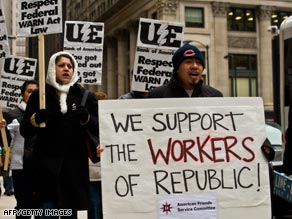
Shaw would probably focus on the malign influence of money, Blago's working-class background, and his desire for greatness fatally undercut by his lack of good faith. I can see one scene including Blago's very public and vocal denunciation of the ever-growing bemoth
Bank of America at the
Republic Windows and Doors Factory sit-in followed by his very public and shocking arrest right thereafter. One of the key elements of Shaw's treatment would, like Shakespeare's, be the monologues each character delivered. Shaw's Blago would probably have a more gilded tongue than the real governor, and almost convince us spectators of his virtue, just as he conned a majority of Illinois voters before his re-election, despite the fact that the festering pustules of corruption that were eventually to burst would be evident to anyone listening to and watching carefully what was unfolding on the stage. Another key element would be comedy, caustic but effective in getting us to see some absurdity at the base of the tragedy before us. I'm not so sure how Shaw might end the play, except to say that we would probably have a bit more sympathy for Blago, which makes me think that the Burris legerdemain would factor in. Now admit it, didn't you have to give Blago props for his audaciousness in pulling this mess off?
August Wilson would probably also include a ghost, but not Nixon. His ghost might be
Martin Luther King Jr., and his focus might be on either
Jesse Jackson Jr., who can give a good speech, or
Roland Burris, whose ego is Shakespearean, to put it mildly. Barack Obama would certainly be part of this cast. Two of Wilson's greatest strengths as a playwright are his compelling poetry and his gift for encapsulating an epoch in a few gestures, conversations, several acts, so I think if he were to focus on Jackson Jr., we might see a contrast between the dreams and actions of his father and the Civil Rights era, and the contemporary moment, when even a Black person can be as corrupt and connected a player as anyone else. He also might give us some of the hidden family drama unfolding among the Jackson clan: imagine the exchanges Wilson could come up with between
Jesse Jackson Sr.;
Jesse Jr.; brother
Jonathan Jackson, who's allegedly linked to the Blago Senate seat selloff; Jesse Jr.'s wife
Sandi, a Chicago City Councilperson; and mother
Jacqueline Jackson. If the men ended up wrestling on the floor, while uttering unforgettable lines, would you be surprised? How would Wilson end the play? With Jesse Jr. alone in his Chicago office, watching a TV set on which Burris was being sworn in as Obama stood by (poetic license, you know)?
Adrienne Kennedy, the only one of the playwrights I've invoked who's still alive and writing, would have a field day with this story if she took it up. I could see parallel narratives, one with Blago being sworn in as president of the US, the other of him in jail, telling the story. He might even be represented by various personalities/selves, designated by grotesque masks or grotesquely made up actors, including one who was actually a version of Richard Nixon, one a version of
John F. Kennedy, another
Richard J. Daley. Or one might be, in outlandish and brilliant Kennedy fashion, a major, tragic female figure from history, like
Queen Anne of Great Britain, or
Joan of Arc. Given Blago's strong support among Black Chicagoans, one self might be
Jean Baptiste Point du Sable! All of them would end up cleverly mixing snippets of Blago's speeches with their own (or invented) words, all undercut by the Blago-in-jail narrator, who would assure us that in fact, the true outcome was that he was elected President, far in the future. I would particularly look forward to the final speech or portion that unraveled or complicated the delusional stance of the governor, and the revelation that the nondescript office was, in effect a jail cell. Kennedy could certainly pull it off.


