Showing posts with label opera. Show all posts

Monday, September 7, 2009

The Gonzales Cantata @ The Rotunda, Philadelphia

Happy Labor Day.

Millions of people all over the US face very tough times right now; the unemployment ranges from the official 9.7% to the morely likely 16.4% or higher, and runs as high as 40% or more in parts of some states, like California, and in some metropolitan areas, particularly among certain groups like African American men and young people. The Obama administration and Federal Reserve chief are touting a recovery that began in August, but so far the country continues to shed jobs, though at a slower rate than before. From what I can tell, there appears to be little indication, despite the helpful suggestions and arguments of labor advocates and workers themselves, employed and unemployed, economists, and others, that those in charge are taking the longer-term issues of labor in this country to heart, except in an abstract sense. The financial industry and multinational corporations appear to be the chief concern of the nation's economic leaders, and our mainstream corporate media. We heard a lot of airy rhetoric about "Main Street," as tiresome a cliche as there is, during the campaign season and again early in the year, but Wall Street continues to hog all the air--and money--in the room, and the neoliberal agenda among the Democrats, and a corporatist right-wing agenda among the GOP, continues unabated. Perhaps one thing to do today is think about the present state of working people, especially working-class and poor people, in this country and globally, and consider ways that you can help to refocus the discussion to ensure that this country and its industries creating viable and sustainable jobs here, but also helping to create conditions for viable and sustainable jobs elsewhere.

Lewis HineLewis Hine (American, 1874-1940)
[Panels for National Child Labor Committee Exhibit], after 1904. Gelatin silver print; 3 1/2 x 5 15/16 in. (8.9 x 15 cm). The Metropolitan Museum of Art, New York, Purchase, The Horace W. Goldsmith Foundation Gift, through Joyce and Robert Menschel, 1993 (1993.43.289)


***

Yesterday we dipped down to the City of Brotherly Love to see Melissa Dunphy's The Gonzales Cantata. As longtime fans of J's Theater know, I'm fond of operas and orchestral music, particularly anything written from the late 19th Century forward, and I'm also a political junkie, so I was very happy when C suggested we check out this piece, which we first learned about from the invaluable Rachel Maddow Show. The Gonzales Cantata, part of the Philly Fringe and Live Arts Festivals, ran for three shows at The Rotunda, a crumbling but beautiful former Christian Science church (meeting house?) and now contemporary performance space designed by the famous early 20th century Beaux Arts architects Hastings and Carrère (architects of my beloved New York Public Library Research Branch, at Bryant Park), on (the edge of) the University of Pennsylvania's campus. I hadn't been to Philadelphia since I gave a reading a few years ago, and hadn't been on Penn's campus since a friend lived right near it a lifetime ago, so I really relished the quick trip from Jersey City.

According to the press materials, Australian native Dunphy quite inventively conceived of the cantata after watching the exasperating (my word) US attorneys firing scandal hearings on TV. How often have you watched our crazy political dramas and thought to yourself, I'm basically watching a (soap) opera? Dunphy did, and then pulled it off. (Hint: someone ought to consider the Blago story as grist for a musical drama of some sort.) She used truncated versions of the hearings transcripts and Gonzales's resignation speech to create her libretto, and then set the words to music that incorporate baroque, classical, Romantic and modernist, but overall tonal, traditions. While the piece did lack narrative drama and drive, its ending already known and its "story" an extended ellipsis whose true backstory remains greatly unknown to us even 2 years later, Dunphy more than made up for it through her confident, charged composition and orchestration, her pragmatic inventiveness in the cantata's construction, and the work's frequent wittiness and use of irony. Since most of the Senators grilling Gonzales were men, Dunphy reversed the performers' genders, so all of the individual male roles, and most of those in the chorus, were sung by women and vice versa. In addition, to highlight the preening quality of the politicians, all of them appeared as sashed pageant contestants, the male Senators in gowns and elegant dresses, crowned with tiaras, the female one (Feinstein), in quasi-white tie. None of the Senators were singled out, at least by Dunphy, for ridicule, their words being enough of an indictment, but the character of Gonzales was structured so as to emphasize the combination of absurdity, idiocy and criminality he embodied during his Attorney General tenure.

One of the highlights of the piece was Dunphy's playful incorporation Gonzales's repetition, 72 times during the original hearings, of "I can't recall" to the Senators' questions about the attorney firings. She also juxtaposed his repeated contradictions of his having been in control and not in control of the firings, and she managed to rekindle real outrage when the chorus recited only a portion of the Bush administration's crimes, including the widespread use of torture and illegal spying on Americans, in which Gonzales played a central role. I personally began asking about halfway through the hour-long piece why Gonzales was not in jail, which provoked a bigger question I think we can never ask enough: why aren't numerous members of the previous administration at the very least on trial, either here in the US, or at the International Criminal Courts, in the Hague.

My abilities to assess voice quality are minimal, but I found most of the individual singers, as well as the chorus, vocally gifted and assured. The young women singing the Gonzales and Senator Pat Leahy parts, and the young man who sang as Feinstein, had pipes. Dunphy conducted a small orchestra of strings and harpsichord, a clever, baroque touch, very deftly, managing to wring an immersive, often dramatic and thrilling soundscape from a tiny ensemble. One of my favorite moments was just before the Senatorial chorus lodges its complaints against Gonzales, and Dunphy switched from a Bachian mood, which in a few spots perhaps didn't work to the best advantage of the piece, beautiful as the music was, to something evoking a Bernard Herrmann score (think Psycho). An addition treat was her orchestration of three "patriotic" songs, including the treacly, jingoistic "Let the Eagle Soar," which were sung often in near falsetto by a very talented tenor and accompanied by the harpsichord and flutes. As you might imagine, the Republican anthem was appropriately syrupy, sentimental, and yet, in its performance, astonishing at the same time.

Some photos:
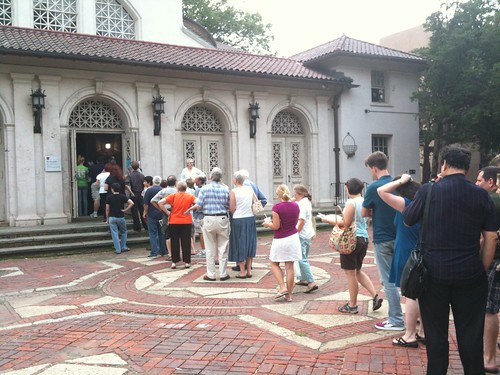
Waiting to enter the performance
The line to enter the Rotunda
A pre-cantata performance of patriotic songs
The perfomance of the patriotic songs
Melissa Dunphy
Composer Melissa Dunphy, during her pre-performance talk
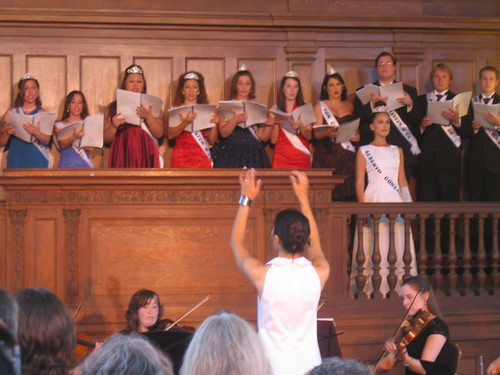
Conductor and chorus
Dunphy, conducting the chorus (The singer of the Gonzales part is at the front of the lectern)
Cantata program and flyer
The Gonzales Cantata program and postcard
The cantata underway
The cantata underway; Leahy stands at the lectern, opening the piece; the supertitles are visible at left; the orchestra, led by Dunphy, is in the chancel area up front
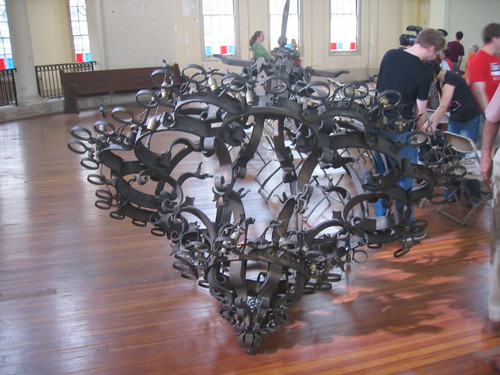
The Rotunda's chandelier/sculpture
The Rotunda's original main chandelier, now a floor sculpture
Alexander Liberman's "Covenant," at Penn
Alexander Liberman's "Covenant," on Locust Walk, University of Pennsylvania campus

Sunday, January 13, 2008

John Adams's Dr. Atomic @ Lyric Opera

Doctor AtomicI don't think I've ever posted about a live opera on this blog, so here's a first go at it. Last night I trooped down to the Lyric Opera of Chicago to see contemporary American composer John Adams's most recent opera, Doctor Atomic. The opera, whose "found text" libretto, staging and direction are the handiwork of impresario Peter Sellars, was first mounted in San Francisco in 2005, and it explores the experiences over monthlong span of several of the central figures involved in the first testing of the atomic bomb, the "Trinity" test, in the New Mexico desert. The protagonist is physicist J. Robert Oppenheimer, but the opera's other important figures include fellow physicist Edward Teller; General Leslie Groves; Oppenheimer's anxious wife Kitty; the weatherman, Jack Hubbard; and the bombastic General Leslie Groves; and Pasqualita, the Oppenheimer's Tewa (Native American) nursemaid.

I should begin by noting my affinity for post-Romantic operas, and in particular for operas (and musicals of operatic cast) from the era of early Modernism on. The sorts of operas that drive purists crazy, such as Debussy's aria-less Pelleas et Mélisande; Bartók's brief and spellbinding Duke Bluebeard's Castle; Schoenberg's unfinished, conceptual masterpiece about the unrepresentability of God, Moses und Aron; Berg's formally intricate case study in pre-World War II decadence, Lulu; Joplin's unique African-American essay in the form, Treemonisha; and Britten's homoerotic homage, Billy Budd, are among the works I cherish, but I also like very current operatic fare, especially works that push opera's aesthetic conventions, such as Philip Glass's Einstein on the Beach and Akhnaten, Steve Reich's Three Tales, and Anthony Davis's Amistad. One of my works, which perhaps drew me to the genre, is Adams's 1987 opera, Nixon in China. It is one of the few very recent operas to have entered the repertoire. In this work, Adams extends his post-minimalist musical language to match Alice Goodman's exceptional libretto, and together they create a powerful portrayal of the soon-to-be disgraced former president's groundbreaking trip to China. Some of the arias, such as Nixon's "News, news," or the reception's choral exchange "Cheers!" have been derided by critics, but the opera also drew immediate praise and has continued to be one of the most popular works of the last 40 years. Its accessibility, blend of humor and drama, biting set pieces, inventive tunefulness, and moments of masterful orchestration and dramatization, such as when Pat Nixon longs for the music of home (California), or Mrs. Mao's aria demonstrating her personal power, probably account for its enduring popularity.

Oppenheimer beholding the bomb, "Doctor Atomic"In Dr. Atomic, Adams shows that his grasp of composition, and in particular scene-painting and orchestration, has only grown in the intervening years. With the exception of the musique concrète tracks that open and close the opera's two halves, the music exemplifies Adams's mastery, both of 20th century music in general and of how to write operatic music in a contemporary vein. Whether it aims for mimesis, as when he portrays the thunder and electrical storms that are threatening the bomb test, or the spectacular choral set pieces, such as the second half's (Act 2, Scene iii) "O, Master" chorus, excerpted from the Bhagavad Gita, which to me was one of the most breathtaking in the entire work, or the arias, by Oppenheimer, his wife, Pasqualita, or Hubbard, who manages to lyricize a weather report (!), Adams never falters--and, I must add, never did the singers, who were on the whole extraordinary. The essentially tonal composition bears Adams's usual fingerprints, eschewing neo-Romanticism in favor of a more complex, pungent assemblage of styles, with moments of hypnotic repetition, contrapuntality and crossrhythms, passages of jazz-like stylings, and controlled dissonance. In fact, it was often the music, along with the sets and staging, that provided what little drama the opera had to offer, and elevated the libretto's inherent poetry, or rather reminded me that I was listening to the words of Baudelaire, Muriel Rukeyser, Donne, among other texts, set to music. There were moments where I simply closed my eyes and listened to the music to relieve the tedium of the libretto, which seemed to stretch on and on unnecessarily.

Although the story itself is inherently dramatic--the government and military are racing to test an atomic bomb to drop on Japan, to end the Second World War, and many of the key scientists involved with it are torn, ethically, morally, emotionally, about their contributions and the possible aftermath of a successful weapon--the libretto, which derives not only from poetry but from declassified government documents, blunts this by telling too much, and thus becoming explanatory, or striving for profundity, which runs aground the shoals of obviousness. In such instances, the narrative's drama sputters, but as in some other operas with little narrative or drama, such as Messiaen's Saint François d'Assise, there are no compensatory character arcs or dramatization, and so Oppenheimer himself remains enigmatic, while Kitty's anxiety, as it never abates, becomes static and tiresome. Then there is the issue of length--too much is, well, too much. Even a marvelous moment, like Oppenheimer's aria based on Donne's "Holy Sonnet No. XIV," "Batter my heart, three-personed God," provoked by his appreciation of the inhuman power the "gadget" he has helped create, just drags on too long. Or perhaps it wouldn't have felt too long if there weren't so many other such moments, where Sellars seems incapable of condensing the text, thus blunting whatever propulsive force the music and narrative manage to generate. The opera runs 3 and 1/2 hours, though it felt like 6; a half-hour of the Robert Wilson-esque quasi-avant-garde processions to literalize the complicated temporality (on figurative and literal levels) and silent moments could easily be cut, and many of the arias could be truncated or at least condensed, saving as much of Adams's music as possible. By the end of the second half, I think the only thing keeping me from bolting was the music and the recognition that I ought not miss the moment of the test, which I'll say disappointed musically and performatively. (By this point a number of the older opera patrons sitting near me had already fled.)

"Doctor Atomic" setThe singers are, as I say above, outstanding, and often wring the most piercing moments out of their arias. Particular notable were Leslie Rivera (what a voice!) as Kitty Oppenheimer, Gerald Finley as J. Robert Oppenheimer, and James Maddalena, the original Richard Nixon in Adams's earlier opera, as Jack Hubbard, the beleaguered weatherman. Eric Owens, playing General Leslie Groves, manages to infuse his ranting-like near-Sprechstimme with real passion, making me wish he'd been given better material to work with. I was less enchanted by Meredith Arwady as Pasqualita; at times she appears to struggle to sustain a continuous rising or descending line, and sounds off key, or perhaps this is how the part was written, though it sticks out beside Rivera's mellifluous declamations. The directing and staging mostly succeed; Sellars is on firmest ground here, and the subtle and unexpected lighting shifts, the always-evocative modular sets, and the lively corps de ballet, match the music and nearly rescue things. One enjoyable side element to the evening was that the grand-daughter of the woman sitting next to me was one of the dancers. She told me she'd come up from Orlando to see her granddaughter dance, and eagerly pointed her out whenever the corps took the stage.

I left the opera house feeling much the way I did when I first went to see John Harbison's The Great Gatsby during its first run at the Met: that I'd heard some great music, but it was expended on a thematically very interesting, above-average, but not great, project. I'm not sure how much tinkering Adams and Sellars will attempt; I missed Sellars's pre-opera talk, but I've read that he acknowledges the libretto's faults, so perhaps they will figure out how to tighten it up if it continues to travel. Cutting the explanatory material, which might mean snipping some of Groves's part, and distilling Kitty Oppenheimer's scenes should be the first order of business. Mirroring the second-half's "O, Master" chorus in the first would also be a good idea, to punch things up a bit. The ending also could use some work; not representing the bomb blast orchestrally is, I admit, brilliant, but I'm not sure the electronic substitute is enough. It almost felt predictable, and kitschy. As it is, I would still recommend anyone interested in contemporary see Doctor Atomic, just to hear Adams's opera, but I'd add that they shouldn't be surprised if they find themselves glancing at their watch, twiddling their thumbs, and wanting to scream get on with it during some of its many, unnecessary longueurs. It's in Chicago until January 19, and moves to the Met in 2008 (they should start with Nixon in China, but then who am I to suggest anything to the Met...).