Here are a few more photos from and several iPad drawings I did during my lulls in that performance of Raymond Roussel's TheDust of Suns! (The supersaturated and black-and-white photos are courtesy of the Hipstamatic app Joel suggested.) I already miss my eyepatch and cape--well, the cape. I shall have to get one, and a top hat as well. Enjoy! "Jacques" from backstage Joel before his scene Excitement building backstage Joel and Joshua, backstage The top-hatted Terojuku tree Before the play During the play Jacob S., backstage Backstage, during the final evening Sarah, backstage, during the play
Yours truly, in cast photos, as M. Valdemont (photo by Jacob K.)
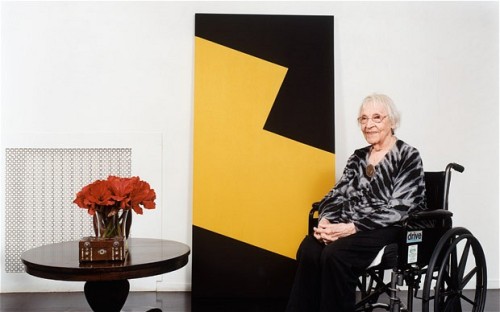
It sometimes is the case that great artists, especially highly original ones or who do not fit the artworld's templates and expectations, may work an entire lifetime and get little or no recognition or notice, and less remuneration. Okay, that sounds a bit depressing, but here's a positive story, about Cuban-born, New York-based artist Carmen Herrera (1915-), discovered at age 89, that has been reported several times over the last year, though I like these two pieces, one in The Telegraph and the other in The Guardian UK, most of the ones I've read about this artist. Both show Herrera to be a hoot, as sharp as a knifeblade and as candid as an open window, with a wit and way with words. (Her poor assistant.) But she also sounds like she could be fun to spend some time with, before you became a bother and prevented her from doing her work, which she is evidently (and thankfully) going to do, with aplomb, until she can't any more. So, take it away, Carmen Herrera! (from the The Telegraph interview, conducted by Helena de Bertodano, "Carmen Herrera: 'Is It a Dream?" reposted at Repeating Islands (by Lisa Paravisini):
‘It’s a very selfish way of doing things – I [Herrera] have to work on it for a while before I come to a decision. Sometimes it takes weeks and sometimes I get stuck.
I get very mad and sometimes I win and sometimes the picture wins. I hate being interrupted when I am working but now I am interrupted all the time.’ She looks at me accusingly and laughs.
‘Really, fame is ridiculous. I didn’t used to bother anyone and no one bothered me. Now I am paying because they are paying me.
‘The money is useful because at the end of life, to my amazement, you need a lot of help. Otherwise I would end up in a nursing home. And I dread that.’
Herrera has four helpers who rotate around the clock, enabling her to stay in the home she has occupied for decades.
I ask her when she moved in. ‘About 18 years ago,’ she says. Bechara, who sits in on part of the interview, intervenes. ‘Come on, darling, 18 years ago! You came here in 1968.’
‘You are very nasty, Tony,’ says Herrera. ‘When you are 95 you will forget your own name.’
If you happen to be in London, her work is currently on exhibit alongside work by Peter Joseph at Lisson Gallery, London NW1, until 29 January 2011.
Red with White Triangle (1961)
***
As has been widely reported, the National Portrait Gallery at the Smithsonian Institution bowed to crass political pressure when it removed the 4-minute excerpt of late artist David Wojnarowicz's (1954-1992) film "A Fire In My Belly" from its landmark queer portraiture exhibit, "Hide/Seek: Difference and Desire in American Portraiture." As the Chicago Tribune's Lauren Vieirareported on Saturday, it was only a month into the show's run when the Catholic League for Religious and Civil Rights, the outfit run by Bill Donohue, denounced the film as "hate speech," based on an 11-second clip in which ants crawl across a crucifix. Shades of L'Age D'Or, etc. The lachrymose incoming Speaker of the House, John Boehner (R-OH), also slammed the work as a waste of taxpayers' money. Said the museum in a December 6th statement, the "Hide/Seek" exhibit would "continue as planned," until February 13, 2010, without Wojnarowicz's film, which allegedly "distracted from the overall exhibition." Ah, thuggery.
In response, some supporters of this particular artist and artwork, queer art and artistic freedom in general, and the rights of public museums not to be bullied have staged protests in Washington and New York City. Vieira adds that a number of private museums and institutions across the country also have obtained permission from Wojnarowicz's estate to show the film; one will be the University of Chicago's Smart Museum of Art, which like several other Chicago-area museums plans to show it early next year, from January 4-February 6, 2011, accompanied by a faculty panel discussion. I am glad that other museums have decided to respond by highlighting the work of Wojnarowicz, who at his death had become one of the most important of the first wave of American artists and writers, and persons with AIDS, addressing the AIDS crisis and its devastating effects. Google to find out if "A Fire In My Belly" is screening near you, and if you're in Chicago in January, the Smart Museum's info is available here.
The 4'11" clip from "A Fire in My Belly" (from semiotexte, via YouTube)
***
As for Haley Barbour's repellent comments today grossly revising the history the white supremacist Concerned Citizens' Councils, please see my blogpost of yesterday, and look carefully at the map of the slavocracy in 1860. Barbour is a Mississippian, and not of the progressive type. I need say no more.
As I mentioned a month or so ago, I'd been trying out the iPad C'd gifted to me, and was enthralled with using the AnimatorHD software on it to create animations, but I've also used it to draw as well. I have not ceased drawing, especially life drawing, with my iPhone, however, and continue my subway portraits and outdoor sketches whenever I can.
One of the things I've been trying is different styles, colors, line thicknesses, to see what I can come up with. My very first drawings were pretty much all line, then I moved to full-color ones, and since this past spring I've moved into grayscale images, but one of the cool aspects of the digital pieces is that I can save them and rework them in different formats, so that my original black-and-white drawing of poet Bob Perelman from earlier this spring became a color portrait without being completely redone (though it did take some effort).
Below are a few of the many sketches I've done over the last month or so; I keep thinking that I may have to return to taking the El on days when I'm not so pressed for time in order to keep my practice up. Enjoy!
One of the things I did while I was back in New Jersey was drop by Kenkeleba Wilmer Jennings Gallery in the East Village to catch the "Abstraction Plus Abstraction" show that's running until early April. This exhibit is showing concurrently with "African American Master Abstractionists" at Anita Shapolsky Gallery, one of the sponsors of the two shows, and together they constitute of the largest shows of important 20th century abstract art by African Americans. Shapolsky, whose gallery roster includes Louise Nevelson, Antoni Tapiès, Karel Appel, Buffie Johnson, and William Saroyan, writes:
This is the first time I am exhibiting an African-American group of artists. My gallery has exhibited black artists over the years in group shows. Many galleries have never shown them. The public should be made aware of good art whoever does it.
The artists in this exhibition are truly masters of Abstraction. The black art movement was helped by the W.P.A., the G. I. Bill (after WWII) and the Civil Rights movement. With all that, most artists had to go to Europe to paint and sell – similar to the jazz musicians of that era. Many of these artists did show in the fifties and early sixties but like all abstract artists, they were eclipsed by the Pop and Minimal movements. Today, many galleries are showing younger artists of all races. This group of first and second generation black artists has fallen through the cracks and should not be forgotten.
I hadn't been over Kenkeleba Wilmer Jennings in a few years (perhaps it was as long ago as 2001-2002, when Chris Stackhouse was part of a group show there), and before that, around 2000, I participated in organizing a show and preparing a catalogue-style pamphlet there, curated by Adrienne Klein and sponsored by my former employer, New York University's Faculty Resource Network, of faculty artists from historically Black colleges and universities (Louis Delsarte, Arturo Lindsay, and others). In any case, I'd never met artist Joe Overstreet, one of the gallery's founders (with his wife, Corinne Jennings) and a major abstract painter himself, but he was there and I got to speak with him briefly about the show, which includes pieces by Betty Blayton, Ed Clark, Sam Gilliam (mentioned in Seismosis, no less), Richard Hunt, Herbert Gentry, Overstreet, as well as landmark artists from an earlier era, like Hale Woodruff, Charles Alston, and Alma Thomas. When I saw that these artists were part of the mix, I realized how important this show was.
I'll let the images speak for themselves, but if you want to catch the concurrent New York shows, you still have a bit of time; there'll also be a show this upcoming fall at the Opalka Gallery at the Sage Colleges in upstate New York.
Anita Shapolsky Gallery 152 East 65th St, NY, NY 10005 (212) 452-1094
Wilmer Jennings Gallery at Kenkeleba 219 East 2nd St, NY, NY 10009 PH: 212-674-3939 Until April 24, 2010
Opalka Gallery will also feature these artists: Opalka Gallery - The Sage Colleges www.sage.edu/opalka November 5 - December 12, 2010
Betty Blayton Forced Center Right, 1975 mixed Media / canvas, 36" Round Joe Overstreet (b. 1933) Untitled Dragon, 1997 Watercolor Alma Thomas (1891-1966) Untitled, 1966 Watercolor on paper Sam Gilliam (b. 1933) Untitled, 1979 Watercolor on shaped paper Charles Alston (1909-1977) Abstraction (ca. 1950) Charcoal on paper Hale Woodruff (1900-1980) Caprice, 1968 Oil on canvas